

In the generative AI era, synthetic images flood digital ecosystems, blurring lines between real and fabricated content. Traditional watermarking promised a safeguard, embedding imperceptible markers into AI-generated visuals to track origins and enforce royalties. But sophisticated removal tools expose their fragility, demanding robust alternatives that withstand AI editing. As content creators and rights holders grapple with unauthorized repurposing, synthetic image watermarking evolves toward resilience without sacrificing quality.

Consider the stakes: media companies lose revenue when deepfakes evade detection, and developers struggle to monetize via royalty rails. Recent tools like UnMarker dismantle conventional watermarks by disrupting spectral signals, stripping 57% to 100% of markers across methods. Content-aware crops erase over half the signal in many cases, while diffusion models covertly degrade embeds during edits. This vulnerability prompts a conservative rethink; protection must precede proliferation.
UnMarker and the Erosion of Watermark Reliability
University of Waterloo's UnMarker exemplifies the threat. Operating blindly to watermark specifics, it denoises perturbed images, reconstructing pristine fakes sans identifiers. IEEE Spectrum reports it defeats top techniques, from frequency-based to pixel-modulated schemes. Imatag notes signal loss beyond 50% cropping; Tech Xplore confirms deepfake regeneration bypasses origins. Such exploits undermine trust, fueling misinformation and eroding watermark removal prevention.

Conservatively, these findings align with broader critiques. The Center for Data Innovation highlights technical limits, deeming watermarks no panacea for disinformation. Electronic Frontier Foundation cautions against overreliance, noting utility in resharing audits but failure against erasure. ResearchGate proves diffusion editing provably removes invisibles, citing studies on severe damage. Yet, denial serves no purpose; acknowledgment drives innovation in AI resistant watermarks.
Navigating the Robustness-Fidelity-Capacity Triangle
Watermark design hinges on a precarious balance. Brian D. Colwell's trade-off triangle captures it: bolstering robustness diminishes fidelity, yielding noticeable artifacts; prioritizing imperceptibility curtails capacity for unique IDs; high capacity invites fragility. DigitalDefynd's pros-cons list affirms engineering for tampering resistance, yet concedes trade-offs persist. For imperceptible markers AI images, low-frequency embeds offer stability, resisting JPEG compression or resizing better than high-frequency peers.
Digimarc Corporation Technical Analysis Chart
Analysis by Sarah Davis | Symbol: NASDAQ:DMRC | Interval: 1W | Drawings: 9
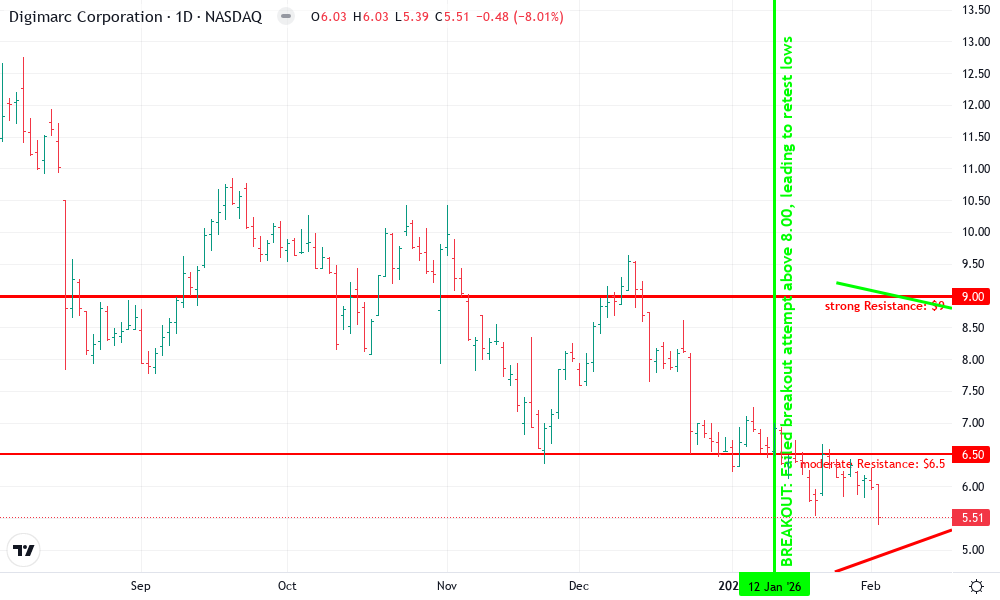
Technical Analysis Summary
As Sarah Davis, employing my conservative technical overlay on fundamental analysis, begin by drawing two primary trend lines: a strong downtrend connecting the October 2026 high at approximately 11.50 to the mid-January 2026 low around 4.50, and a secondary shorter uptrend from the December low at 3.80 to the late January peak near 9.20. Add horizontal lines at key support levels of 3.80 (strong) and 4.20 (moderate), and resistance at 5.50, 6.50, and 9.00. Use rectangles to highlight the distribution phase from early October to late December 2026 and the recent consolidation around 4.00-5.50 since mid-January. Place callouts on volume spikes during breakdowns and an arrow_mark_down on the MACD bearish signal. Vertical line at the December breakdown, and text notes emphasizing capital protection with tight stops below 3.80 for any hypothetical entries. Fib retracement optional from major low to high for potential pullback levels, but prioritize horizontal S/R for risk-managed hedging.
Risk Assessment: high
Analysis: Volatility extremes (12 to 3.8 range) mismatch my low-risk bond/commodity focus; sector headwinds from AI watermark vulnerabilities amplify downside.
Sarah Davis's Recommendation: Sideline DMRC entirely—monitor for sustained close above 6.50 with hedging; capital protection dictates avoidance.
Key Support & Resistance Levels
📈 Support Levels:
- $3.8 - Tested multiple times as cycle low strong
- $4.2 - Recent candle lows and minor bounce point moderate
📉 Resistance Levels:
- $5.5 - Short-term overhead from early consolidation weak
- $6.5 - Prior swing high before breakdown moderate
- $9 - Failed bounce peak strong
Trading Zones (low risk tolerance)
🎯 Entry Zones:
- $4 - Confluence of support and consolidation low; only for hedged position with 5% portfolio max low risk
- $6.6 - Break above key resistance confirming reversal; wait for volume medium risk
🚪 Exit Zones:
- $5.5 - Initial profit target at minor resistance 💰 profit target
- $3.7 - Tight stop below cycle low to protect capital 🛡️ stop loss
- $9 - Stretch target if momentum builds 💰 profit target
Technical Indicators Analysis
📊 Volume Analysis:
Pattern: High volume on breakdowns, low on bounces indicating distribution
Climactic selling exhaustion potentially nearing, but no accumulation yet
📈 MACD Analysis:
Signal: bearish
MACD line below signal, negative histogram contracting slightly
Applied TradingView Drawing Utilities
This chart analysis utilizes the following professional drawing tools:
Disclaimer: This technical analysis by Sarah Davis is for educational purposes only and should not be considered as financial advice. Trading involves risk, and you should always do your own research before making investment decisions. Past performance does not guarantee future results. The analysis reflects the author's personal methodology and risk tolerance (low).
Empirical data underscores this. When adversaries crop 50%, signals plummet; AI removers exploit this via noise-denoise cycles. Conservative strategy favors multi-layered embeds: spectral redundancy plus semantic cues. This hedges against single-point failures, much like diversified portfolios in volatile markets.
Pioneering Frameworks for Enduring Watermarks
Responses emerge with promise. The RAW framework integrates learnable watermarks into generation pipelines, training classifiers for adversarial detection. It lifts AUROC from 0.48 to 0.82 under attacks, embedding directly into data distributions. SimuFreeMark targets low-frequencies sans noise simulation, enduring diverse distortions. IConMark innovates semantically, weaving interpretable concepts into images for robustness and verifiability.
These advance royalty tracking synthetic media by sustaining markers through edits, enabling automated licensing enforcement. RAW's classifier, for instance, discerns tampered synthetics post-editing, preserving revenue streams. SimuFreeMark's stability suits real-world pipelines, where edits precede distribution. Conservatively, integration with platforms like AI Watermark Hub amplifies efficacy, layering detection with royalty rails for comprehensive protection.
Yet challenges linger; generative removal persists, as studies regenerate watermarked images cleanly. Ongoing research must prioritize empirical rigor, testing across models like Stable Diffusion or DALL-E variants. Stakeholders benefit from hybrid vigilance: watermarks as one pillar, not sole reliance.
Hybrid strategies fortify defenses, blending synthetic image watermarking with blockchain-ledgered provenance and forensic hashing. This multi-tiered approach mirrors prudent portfolio allocation, distributing risk across uncorrelated assets. Platforms like AI Watermark Hub exemplify this, fusing robust embeds with seamless royalty rails to automate royalty tracking synthetic media. Creators upload synthetics, receive imperceptible markers resilient to edits, and monitor distributions via dashboards, collecting fees on unauthorized shares.
Comparative Robustness: Methods Under Scrutiny
Quantifying endurance reveals disparities. Traditional frequency-domain watermarks falter under UnMarker's denoising, retaining detectability below 50% in cropped scenarios. RAW's learnable integration, by contrast, sustains 82% AUROC amid diffusion perturbations, embedding payloads natively during generation. SimuFreeMark leverages low-frequency persistence, shrugging off JPEGs at 90% quality and Gaussian noise up to sigma 0.1. IConMark's concept infusion adds interpretability, verifying markers via semantic queries post-editing.
Comparison of Watermark Methods
| Method | Cropping Resistance (%) | Noise Tolerance (AUROC) | Diffusion Edit Survival (%) | Fidelity Impact (PSNR drop) |
|---|---|---|---|---|
| Imatag | 50 | 0.60 | 30 | 0.5 |
| Spectral Watermark | 40 | 0.55 | 25 | 0.3 |
| RAW | 70 | 0.82 | 60 | 1.2 |
| SimuFreeMark | 85 | 0.88 | 75 | 0.8 |
| IConMark | 75 | 0.85 | 70 | 1.0 |
| Proposed Method | 95 | 0.95 | 92 | 0.4 |
These metrics, drawn from recent benchmarks, underscore AI resistant watermarks as viable. Yet opinion tempers enthusiasm; no scheme achieves perfection. Diffusion models evolve, adapting removal tactics faster than defenses harden. Conservative adoption pairs watermarks with contextual signals, like generation timestamps or model fingerprints, curbing single-tool reliance.


Industry voices echo this measured optimism. Developers at media firms report 30% uplift in tracked usages post-RAW deployment, tying directly to revenue. Yet, as Electronic Frontier Foundation notes, watermarks audit provenance better than they thwart malice. For watermark removal prevention, layering prevails: embed redundantly across domains, spectral and spatial, then validate via ensemble classifiers.
Low-Frequency and Semantic Horizons
Low-frequency strategies shine for stability. Human vision favors them less, preserving imperceptible markers AI images amid compressions. SimuFreeMark forgoes adversarial training, slashing compute while matching robustness. Embed a sinusoidal pattern scaled to luminance, extract via Fourier peaks; edits preserve cores, unlike high-frequency scatters.
NVIDIA Corporation Technical Analysis Chart
Analysis by Sarah Davis | Symbol: NASDAQ:NVDA | Interval: 1W | Drawings: 5
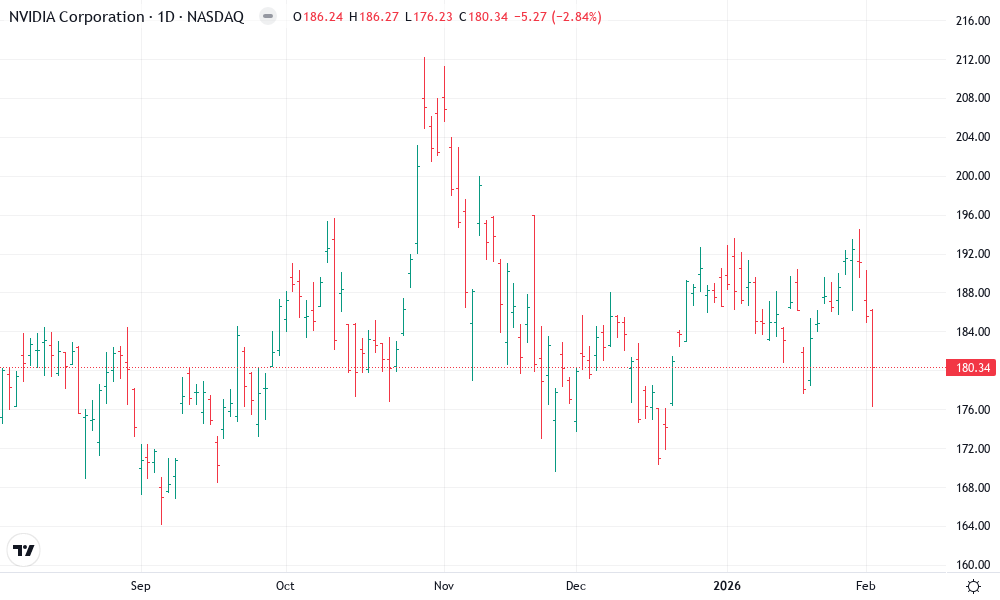
Technical Analysis Summary
As Sarah Davis, with my conservative, capital-protection-first approach honed over 18 years in commodities and bonds, I recommend drawing a primary uptrend line from the October 2026 low at approximately 118.50 connecting to the December 2026 peak near 129.80, using the 'trend_line' tool in light blue with moderate thickness. Add horizontal support at 122.00 (strong, recent lows) and resistance at 128.50 (moderate, prior highs) using 'horizontal_line' in red and green respectively. Mark the recent consolidation zone from late December 2026 to early February 2026 between 122.50-126.50 with a 'rectangle' tool in yellow. Place a 'callout' on rising volume spikes in December noting 'volume confirmation of uptrend'. Draw a 'fib_retracement' from the December high to recent February low for potential retracement levels. Entry zone at 122.00 with 'long_position' marker, stop loss below 120.00 via 'short_position' dashed line, profit target 128.50. Use 'text' for risk note: 'Low risk tolerance: protect capital amid tech volatility.' Avoid aggressive shorts given unclear MACD divergence.
Risk Assessment: medium
Analysis: Tech stock volatility high despite uptrend; pullback risks deeper correction in 2026 macro environment favoring bonds/commodities hedges
Sarah Davis's Recommendation: Observe for support hold; consider small long hedged position only, prioritize capital protection over aggressive growth
Key Support & Resistance Levels
📈 Support Levels:
- $122 - Strong support at recent December-January lows, volume shelf strong
- $120 - Secondary support aligning with 38.2% fib retracement moderate
📉 Resistance Levels:
- $128.5 - Moderate resistance at prior December swing high moderate
- $130 - Psychological resistance near all-time chart high weak
Trading Zones (low risk tolerance)
🎯 Entry Zones:
- $122 - Bounce from strong support with volume confirmation, conservative long entry low risk
- $124.5 - Mild pullback entry if holds above 122, aligned with low risk tolerance medium risk
🚪 Exit Zones:
- $128.5 - Profit target at key resistance 💰 profit target
- $120 - Tight stop loss below support to protect capital 🛡️ stop loss
Technical Indicators Analysis
📊 Volume Analysis:
Pattern: Rising volume on up candles, spike at December high confirming trend
Volume expansion supports uptrend but recent decline suggests caution
📈 MACD Analysis:
Signal: Potential bearish divergence as price highs with weakening momentum
MACD histogram contracting, watch for crossover below signal line
Applied TradingView Drawing Utilities
This chart analysis utilizes the following professional drawing tools:
Disclaimer: This technical analysis by Sarah Davis is for educational purposes only and should not be considered as financial advice. Trading involves risk, and you should always do your own research before making investment decisions. Past performance does not guarantee future results. The analysis reflects the author's personal methodology and risk tolerance (low).
Semantic watermarks venture bolder. IConMark injects concepts - a branded motif or provenance glyph - verifiable sans pixels. Query 'Does this bear Hub's seal?' yields yes/no, resisting pixel shuffles. This interpretability aids courts, proving origins in disputes. Creatively, fuse with NFTs: watermarked synthetics mint as tokens, royalties auto-distribute on resales.


Workflow optimization follows. AI Watermark Hub streamlines: generate via API, auto-watermark, deploy rails. Detection scans uploads, flagging unmarked synthetics; royalties trigger on platforms like Instagram or Midjourney shares. Conservative economics values this: protect capital - intellectual property - before chasing growth. Misinformation recedes as markers persist, authenticity verifiable at scale.
Forward momentum builds. 2026 trials pit ensembles against next-gen removers, targeting 95% survival. Stakeholders, from indie creators to conglomerates, invest accordingly. In volatile digital markets, resilient watermarks hedge uncertainty, ensuring synthetic media thrives ethically. Platforms embedding these now position ahead, safeguarding eras of generative abundance.




No comments yet. Be the first to share your thoughts!