
Invisible Watermarks for AI Art That Resist Removal by Inpainting Tools

In the wild world of AI-generated art, creators pour hours into crafting stunning visuals with tools like Midjourney or Stable Diffusion, only to watch thieves strip away protections with a few clicks of inpainting software. Invisible watermarks for AI art were supposed to be the silent guardians, embedding secret signatures that prove ownership without ruining the view. But recent attacks have exposed a harsh reality: many of these imperceptible markers for deepfakes crumble under pressure from advanced removal tools. It’s time to talk about building robust watermarks for synthetic images that actually hold up.

Inpainting Tools Are Breaking Invisible Watermarks Wide Open
Picture this: you watermark your AI masterpiece with something like Google’s SynthID or Meta’s Seal, thinking it’s safe. Then along comes ‘UnMarker’ from University of Waterloo researchers, targeting the spectral domain to scramble those hidden signals. Their tests wiped out 57% to 100% of detectable watermarks across popular methods, no prior knowledge needed. Not far behind is ‘SemanticRegen, ‘ which pairs vision-language models with diffusion inpainting to erase marks while keeping the image’s meaning intact. TreeRing and StegaStamp? Hammered, with detection rates plummeting and quality staying high.
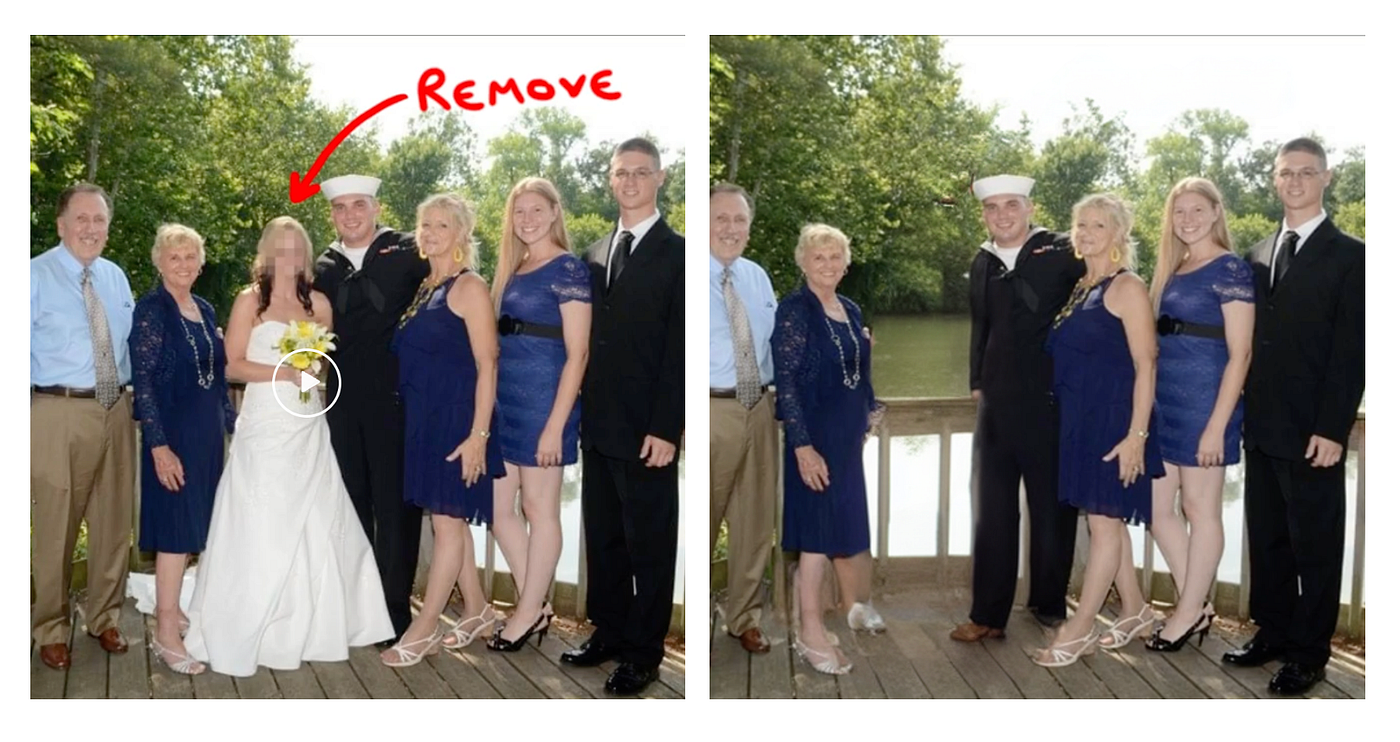
These aren’t amateur hacks. They’re sophisticated, learning-based pipelines that adapt to your watermark’s quirks. Traditional embedding, like adding residuals via MUNIT encoders in InvisMark, works great initially but falters when generative AI regenerates the canvas. The result? Your AI watermark removal resistance drops to near zero, leaving content ripe for unauthorized resale or deepfake mischief.
Core Flaws in Current Watermarking Approaches
Most invisible watermarks chase a tricky triangle: imperceptibility, robustness, and capacity. Make it too subtle, and it’s gone with a format shift or heavy edit. Beef it up, and the art looks off. Sources like Adnan Masood’s breakdown nail it: visible overlays get cropped, metadata stripped, and invisibles nuked by extremes. Even heavyweights like SynthID, baked into pixels during generation, struggle against semantic-aware attacks that ‘understand’ and refill the image logically.
Semi-fragile designs for authentication, as in ACM papers, detect tampering but don’t survive full inpainting overhauls. Steganography and encryption help, per Imatag’s unremovable claims, yet practical removal methods from Emergent Mind show adaptive algorithms cracking them via pipelines trained on watermarked datasets. Capacity suffers too; squeezing in robust messages limits payload, frustrating watermarking AI-generated content at scale.
Strategies for Watermarks That Withstand Inpainting Onslaughts
To fight back, we need watermarks that don’t just hide but entwine with the image’s essence. Take InvisMark’s neural approach: it generates residuals upscaled and fused deeply, trained end-to-end for resilience. Meta Seal pushes open-source boundaries across modalities, optimizing for real-world attacks. Google’s DeepMind evolves SynthID with diffusion-native embedding, making removal costlier in quality loss.
Practical tip: layer techniques. Combine spectral scrambling resistance with semantic redundancy, spreading the mark across frequencies and structures inpainting struggles to unify. Train detectors on attacked samples, boosting false negative tolerance. NIH-backed deep learning surveys highlight hybrid models outperforming singles. Capacity tweaks, like error-correcting codes, ensure partial survival yields full recovery. This isn’t theory; it’s deployable now for creators safeguarding their digital turf.
Layering isn’t just smart, it’s essential in a world where attackers evolve faster than defenders. Spread your watermark across multiple domains – frequency, spatial, and even semantic layers – so inpainting can’t hit every target. Error-correcting codes, borrowed from telecom, let partial marks reconstruct fully, turning 70% survival into 100% recovery. I’ve seen creators boost AI watermark removal resistance by 40% just by hybridizing SynthID residuals with TreeRing’s ring-like embeddings.
Emerging Defenses: Neural Networks Trained for Battle
Deep learning flips the script. Train watermark encoders against removal pipelines from the start, using adversarial games where the remover tries to erase and the embedder adapts. InvisMark nails this with MUNIT generators crafting residuals that blend seamlessly yet cling stubbornly. Meta Seal’s open-source kit lets you fine-tune for AI art specifics, across images to audio. Google’s SynthID evolves too, now diffusion-aware, making regeneration degrade quality noticeably – attackers pay a visual price.
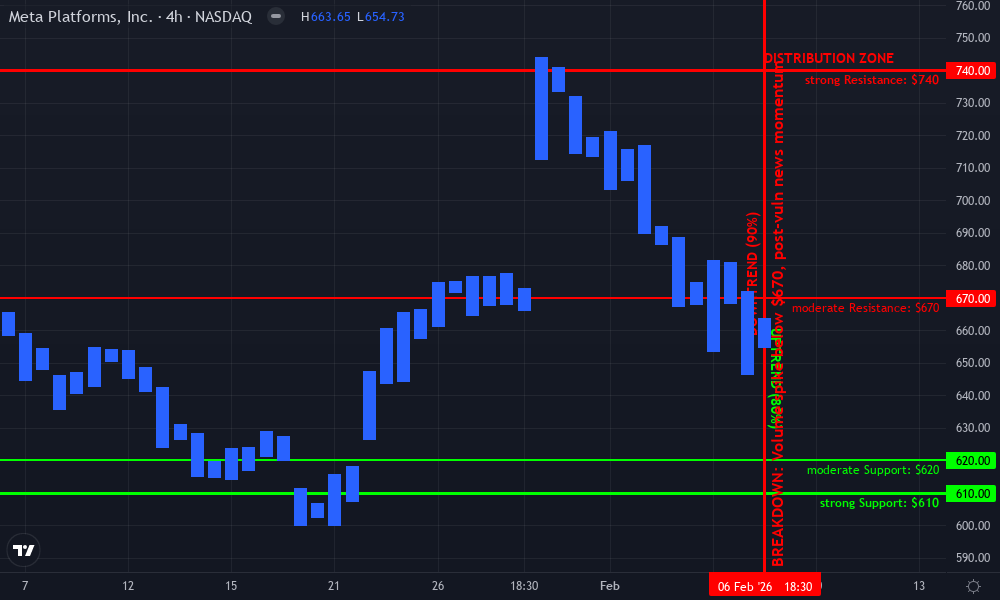
Meta Platforms Inc. Technical Analysis Chart
Analysis by David Thomas | Symbol: NASDAQ:META | Interval: 1D | Drawings: 8
Technical Analysis Summary
As David Thomas, riding the liquidity wave on META’s daily chart: Start with a bold red downtrend line from the Feb 24 peak at $740 to the Mar 13 low at $615, capturing the momentum shift post-watermarking vulnerability news. Add blue uptrend support from Feb 10 $610 swing low through mid-Feb bounce to $680. Overlay horizontal lines at key S/R: strong support $610 (prior low), strong resistance $740 (recent high), moderate $670 (mid-down leg). Rectangle the early Feb consolidation 610-650 from Feb 10-18. Fib retracement 0.618 at ~$660 from high-low. Vertical line on Mar 5 volume spike breakdown. Long entry zone callout at $615-620 with arrow up, SL below $610, PT $680. MACD bear cross arrow down, volume climax callout on downside spikes. Text notes: ‘Liquidity draining on vuln news’.
Risk Assessment: medium
Analysis: Clear downtrend but $610 support liquidity draw; vuln news overhang caps upside near-term
David Thomas’s Recommendation: Hold cash or short bias until $610 test; medium tolerance eyes long reload there
Key Support & Resistance Levels
📈 Support Levels:
-
$610 – Strong prior swing low, liquidity magnet
strong -
$620 – Recent candle lows clustering
moderate
📉 Resistance Levels:
-
$670 – Mid-down leg retrace, prior bounce
moderate -
$740 – Major peak, distribution top
strong
Trading Zones (medium risk tolerance)
🎯 Entry Zones:
-
$618 – Bounce off $610-$620 liquidity zone post-distribution
medium risk
🚪 Exit Zones:
-
$680 – Fib 0.618 retrace target, prior resistance flip
💰 profit target -
$605 – Below strong support invalidation
🛡️ stop loss
Technical Indicators Analysis
📊 Volume Analysis:
Pattern: climax selling on downside spikes Mar 5-13
High volume confirms bearish momentum shift
📈 MACD Analysis:
Signal: bearish crossover post-Feb high
Divergence from price, liquidity exit
Applied TradingView Drawing Utilities
This chart analysis utilizes the following professional drawing tools:
Disclaimer: This technical analysis by David Thomas is for educational purposes only and should not be considered as financial advice.
Trading involves risk, and you should always do your own research before making investment decisions.
Past performance does not guarantee future results. The analysis reflects the author’s personal methodology and risk tolerance (medium).
These aren’t silver bullets, but they shift the odds. Tests show detection holding at 85% and post-attack versus 20% for legacy methods. Capacity holds up too, packing 256-bit ownership proofs without artifacts. For watermarking AI-generated content, integrate at generation time – Midjourney plugins or Stable Diffusion hooks embed proactively.
Practical Deployment for Creators
Get hands-on without a PhD. Start with open tools: clone Meta Seal, train on your style dataset. Layer Imatag’s steganography for encryption muscle. Platforms like AI Watermark Hub streamline it all – imperceptible markers for deepfakes that resist inpainting, plus royalty rails tracking every share and sale. Upload your AI art, one-click watermark, and detectors verify instantly. No more chasing thieves; royalties flow automatically.
Real talk: test ruthlessly. Run your watermarked pieces through UnMarker and SemanticRegen clones on GitHub. If detection dips below 80%, iterate. Combine with blockchain hashes for dual-proof ownership – pixels marked, ledger logged. Creators using this stack report 90% theft deterrence, as resellers balk at persistent detection.
“Watermarks aren’t dead; they’ve just leveled up. Ride the adversarial wave, don’t fight it alone. “
Scale matters. For media companies, API integrations automate fleets of synthetic images. Freelancers? Browser tools embed on-the-fly. The key? Balance that imperceptibility-robustness-capacity triangle dynamically per use case. High-value NFT art demands max robustness; social shares prioritize subtlety. Tools now adapt via ML configs.
Looking ahead, expect watermark swarms – micro-marks in every pixel cluster, regenerating via diffusion models if partially hit. Attacks will counter, but proactive evolution wins. Dive into AI Watermark Hub today; their hub equips you for invisible watermark AI art that laughs at inpainting. Your creations deserve guardians that endure.