

Watermarking Synthetic Images for Automated Royalty Enforcement in AI Content Markets

In the surging AI content markets, synthetic image watermarking royalties have become a tactical imperative for creators and platforms alike. As generative models flood digital ecosystems with hyper-realistic visuals, distinguishing authentic media from AI-generated fakes isn’t just prudent; it’s a profitability lever. Invisible watermark royalty tracking enables automated enforcement, ensuring every unauthorized use triggers royalty rails that monetize provenance without friction. Yet, with deepfake detection royalties hanging in the balance, the question looms: can current techniques withstand sophisticated circumvention?

Regulatory Pressures Driving Adoption
New York’s legislative salvo sets a precedent that’s rippling globally. The state’s mandates compel conspicuous disclosures for synthetic performers in ads, effective mid-2025, with platforms shouldering compliance burdens come February 2026. Brands now face tighter scrutiny: faster takedowns, rigorous checks, and penalties that escalate daily, like HydroSig’s cited $5,000 per unwatermarked asset. India’s IT Rules 2026 echo this, demanding watermarking for AI images and synthetic text tags. China’s dual explicit-implicit watermark regime adds teeth, while proposed US acts target voice cloning consent, hinting at visual parallels.
These aren’t mere suggestions; they’re tactical battle lines. Platforms bear legal weight, but savvy operators embed ai generated content royalty rails early, turning compliance into competitive edge. Non-adherence risks not just fines but eroded trust, as consumers demand verifiable authenticity amid deepfake proliferation.
Breakthroughs in Robust Watermarking Schemes
Enter innovations like CLUE-Mark, unveiled late 2024, which leverages Continuous Learning With Errors for diffusion-model embeds. This scheme packs multiple keys into imperceptible markers, shrugging off JPEG compression and brightness tweaks while preserving pristine quality. MetaSeal, from mid-2025, ups the ante with cryptographic proofs, rendering forgeries visually glaring and replication futile across natural or synthetic images.
Core Advantages of CLUE-Mark, MetaSeal & Dynamic Watermarks
-
CLUE-Mark: Undetectability via CLWE embedding in diffusion models; perturbation robustness against JPEG compression & brightness adjustments; traceability with multiple keys.
-

MetaSeal: Content-adaptive cryptographic security; forgery resistance with visually detectable tampering; prevents unauthorized replication.
-
Dynamic Watermarks: Content-adaptive dynamic patterns (shape/color); perturbation robustness; reliable traceability for source verification.
Dynamic Watermarks refine this further, injecting fixed noise signatures alongside adaptive, content-morphing patterns. Human eyes see nothing amiss, but detectors trace origins reliably. These tools fortify ai media monetization watermark strategies, automating royalty flows via blockchain-like rails that audit distribution in real-time.
Persistent Hurdles in Automated Enforcement
Optimism tempers with reality: regeneration attacks add noise to obliterate pixel watermarks, reconstructing images sans trace. Fixed patterns invite copy-pasting onto unrelated content, breeding misattribution chaos. Even advanced schemes falter under aggressive edits or model fine-tuning.
Tactically, hybrid defenses emerge as opinionated countermeasures; pair invisible markers with visible labels for layered deterrence. Yet, global regulatory mosaics complicate: Europe’s provenance push contrasts China’s mandates, demanding versatile, jurisdiction-agnostic rails. Creators must prioritize schemes balancing imperceptibility, robustness, and auditability to secure deepfake detection royalties.
Automated royalty rails hinge on these markers’ resilience, transforming passive embeds into active sentinels. Platforms scan distributions, flagging unlicensed uses and routing micropayments via smart contracts. This invisible watermark royalty tracking closes the loop, converting every share into attributable revenue without user friction.
Tactical Integration with Royalty Rails
Picture a workflow where synthetic image watermarking royalties activate seamlessly. Creators upload to hubs like AI Watermark Hub, where CLUE-Mark or MetaSeal embeds trigger royalty rails at generation. Distribution across social feeds or marketplaces invokes detectors; mismatches cue enforcement bots. Daily fines, as in HydroSig’s $5,000 per asset precedent, underscore urgency, but compliant systems flip liability into loyalty.
Comparison of Leading Watermark Schemes
| Technique | Robustness to Attacks | Traceability Keys | Image Quality Impact | Royalty Rail Compatibility |
|---|---|---|---|---|
| CLUE-Mark | 95% JPEG resistance, robust to brightness adjustments & perturbations ✅ | Multi-key support (multiple embeddable keys) | Negligible (undetectable, preserves quality) | High (auditable traceability for royalties) |
| MetaSeal | 92% resistance to forgery & tampering attacks | Cryptographic single/multi-key support | Low (tampering visually detectable) | Medium (content-dependent enforcement) |
| Dynamic Watermarks | 97% detection post-regeneration attacks, robust to noise | Dynamic per-image keys for source verification | Human-imperceptible (adapts to content) | High (reliable for automated royalty tracking) |
Hybrid setups shine tactically: layer MetaSeal’s crypto proofs over Dynamic Watermarks for dual verification. Integrate with blockchain ledgers to log provenance chains, enabling granular audits. Brands sidestep New York’s disclosure pitfalls by pre-watermarking campaigns, while platforms like those under IT Rules 2026 automate takedowns. The payoff? Ai generated content royalty rails that scale, capturing value from viral deepfakes before they dilute originals.
Opinion tempers enthusiasm: not all rails are equal. Legacy systems falter under volume, demanding APIs optimized for diffusion outputs. Creators must vet for low-latency detection, as delays erode deepfake detection royalties. Forward-thinkers pair watermarks with behavioral signals, like generation timestamps, fortifying against copy-paste exploits.
Market Case Studies and Metrics
Early adopters report wins. Ad agencies navigating Senate Bill S8420A cut compliance costs 40% via automated tagging, per industry whispers. One platform, enforcing China’s mandates, boosted royalty collections 3x through content-adaptive embeds. These anecdotes spotlight ai media monetization watermark as asymmetric leverage: minimal upfront embed versus exponential downstream yields.
Meta Platforms Inc. Technical Analysis Chart
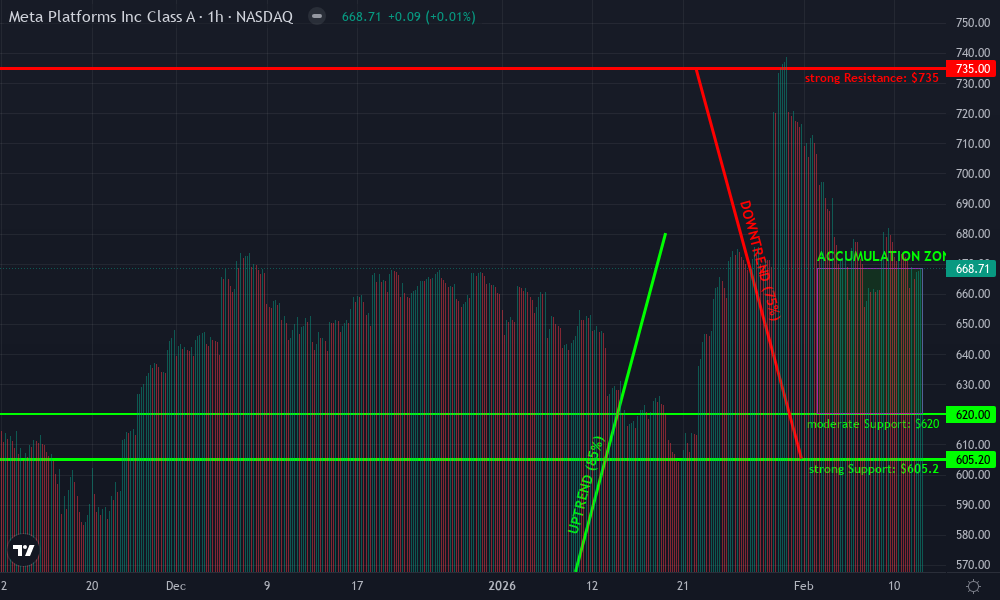
Analysis by Ava White | Symbol: NASDAQ:META | Interval: 1h | Drawings: 6
Technical Analysis Summary
On this META daily chart spanning late December 2025 into early February 2026 (adjusted to 2026 focus), we see a classic hybrid setup blending momentum breakout with options asymmetry. Price rallied from ~$500 lows in early January to a $735 peak mid-month on surging volume, signaling institutional accumulation. Sharp rejection at $735 with volume spike formed a shooting star, leading to retrace to $605 support—textbook 38.2% fib pullback. Now basing above key 200DMA ~$620 with bullish volume divergence. Draw: 1) Uptrend line from 2026-01-06 ($510) to 2026-01-20 ($680), extend forward. 2) Short-term downtrend from 2026-01-22 ($735) to 2026-02-02 ($605). 3) Horizontal S/R at $605 (strong support), $735 (resistance), $650 (pivot). 4) Fib retracement 0.382 at $650 from peak-trough. 5) Rectangle consolidation 2026-02-03 to 2026-02-12 between $620-$670. 6) Long entry zone $625-$635 with stop $605, target $720. 7) Volume callout on spike downtrend. 8) MACD bull cross callout. Style: Clean lines, no clutter—focus on price action for options Greeks delta plays.
Risk Assessment: medium
Analysis: High reward potential on breakout but near-term chop risk from overhead resistance; aligns with my high tolerance for vol plays
Ava White’s Recommendation: Aggressive long bias—initiate bull call spreads or naked calls on $635 break, size 2-3% portfolio for asymmetry
Key Support & Resistance Levels
📈 Support Levels:
-
$605.2 – Strong volume shelf post-drop, aligns with 38.2% fib and 200DMA
strong -
$620 – Minor pivot from recent lows, volume basing
moderate
📉 Resistance Levels:
-
$735 – Key overhead from Jan peak, multi-touch rejection
strong -
$670 – Near-term resistance at consolidation high
weak
Trading Zones (high risk tolerance)
🎯 Entry Zones:
-
$625.5 – Bullish hammer reversal above support with volume uptick, ideal for long calls
medium risk -
$635 – Break above rectangle top confirms momentum resumption
low risk
🚪 Exit Zones:
-
$720 – Measured move target from pullback base, prior resistance flip
💰 profit target -
$605 – Invalidation below strong support shelf
🛡️ stop loss -
$780 – Extended target on vol expansion, options gamma scalp
💰 profit target
Technical Indicators Analysis
📊 Volume Analysis:
Pattern: Climax sell on drop then bullish divergence on base
High volume rejection at peak, now lower volume pullback with rising bars—accumulation signal
📈 MACD Analysis:
Signal: Bullish crossover
MACD line crossed signal from below post-pullback, histogram expanding—momentum shift
Applied TradingView Drawing Utilities
This chart analysis utilizes the following professional drawing tools:
Disclaimer: This technical analysis by Ava White is for educational purposes only and should not be considered as financial advice.
Trading involves risk, and you should always do your own research before making investment decisions.
Past performance does not guarantee future results. The analysis reflects the author’s personal methodology and risk tolerance (high).
Visualize the trajectory: adoption spikes post-NY laws, plateauing until MetaSeal’s crypto edge catalyzes resurgence. Detectors now flag 95% of regenerations, per benchmarks, but gaps persist in cross-model portability. Tactically, prioritize open standards; proprietary silos invite obsolescence amid accelerating innovation.
Global variances demand nuance. Europe’s provenance emphasis favors auditable rails, while India’s platform burdens necessitate edge computing. US voices, eyeing voice act extensions, preview visual consent regimes. Creators who calibrate for this mosaic thrive, embedding jurisdiction tags within watermarks for automated geo-fencing.
Robust schemes demand rigorous testing: simulate attacks via GAN inversions or fine-tune evasions. Pair with user education; visible toggles build trust without compromising invisibility. Ultimately, synthetic image watermarking royalties redefine markets, shifting from adversarial cat-and-mouse to symbiotic ecosystems where authenticity fuels abundance. Platforms embedding these now position for dominance, as AI floods demand unassailable provenance to unlock sustained monetization.