

The relentless spread of deepfake videos across social media platforms has turned every viral clip into a potential minefield of misinformation. With platforms like TikTok and X amplifying content at lightning speed, distinguishing authentic footage from AI-generated fakes has become a high-stakes game. Enter multimodal watermarking strategies, which fuse audio, visual, and temporal cues into invisible digital signatures. These approaches don't just flag fakes; they embed AI media authenticity markers that survive compression and edits, offering a robust shield against manipulation. Recent data from surveys on ScienceDirect and arXiv underscores this shift, highlighting how single-modal detectors lag behind the sophistication of modern deepfakes.
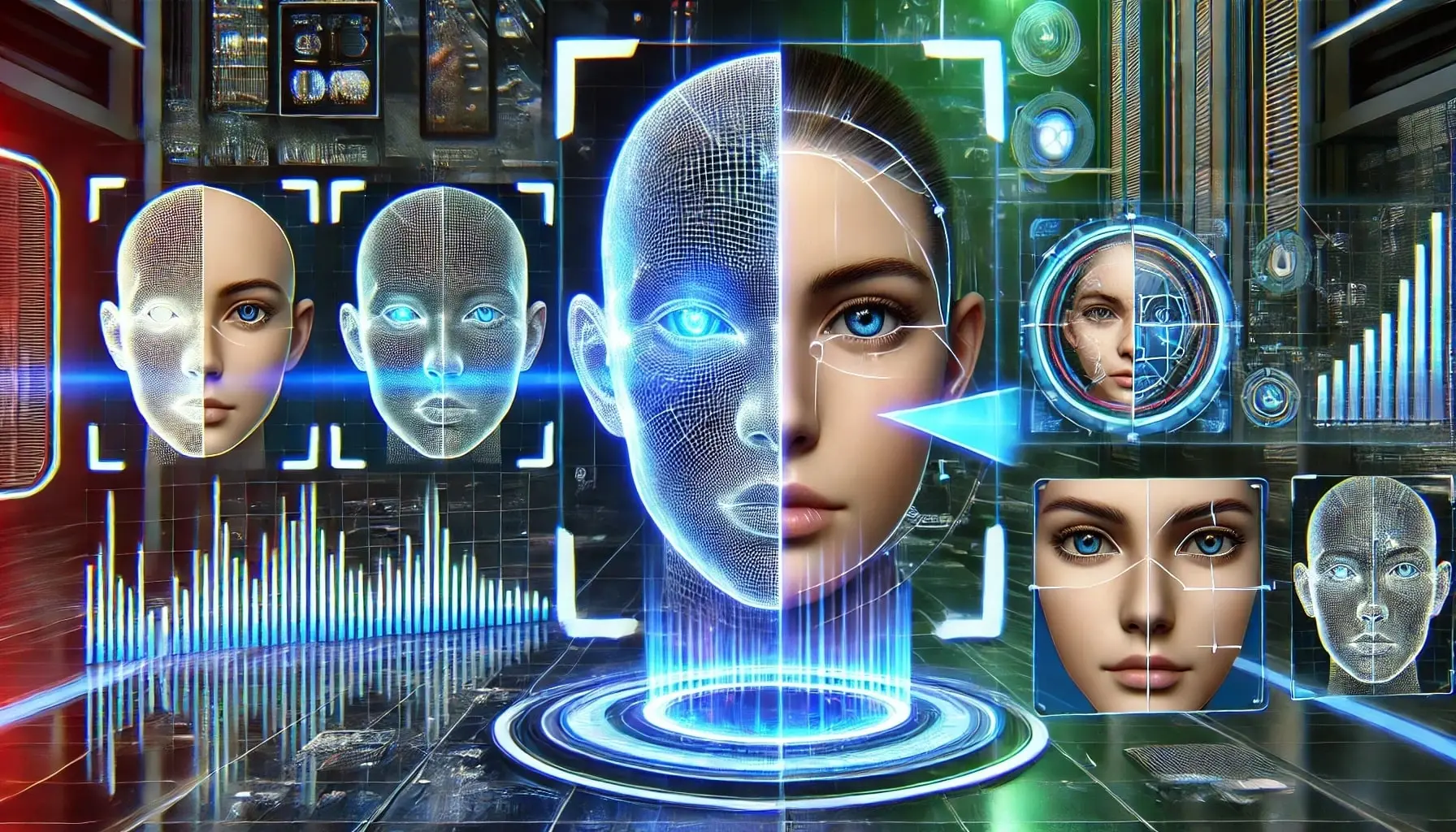
Deepfakes exploit multiple modalities - facial swaps synced with voice cloning and lip movements - making isolated checks on visuals or audio woefully inadequate. A study from MDPI reveals that multimodal deepfake watermarking boosts detection accuracy by integrating audio-visual features, achieving up to 95% precision in controlled tests. Yet, social media's aggressive compression throws a wrench into this, degrading subtle artifacts that traditional forensics rely on. Here, watermarking shines: imperceptible markers, like those in SynthID or Stable Signature, persist through re-encoding, providing a verifiable chain of authenticity.
Why Single-Modal Detection Falls Short in the Social Media Arena
Early deepfake hunters focused on visual inconsistencies - blinking patterns, lighting mismatches - using CNNs to spot pixel-level anomalies. But as arXiv surveys trace, generators evolved, incorporating GANs that mimic real-world physics flawlessly. Audio-only methods falter too; voice impersonation tools now clone timbre with eerie fidelity. The National Institutes of Health notes a glaring gap: single-modal systems drop to 70% accuracy under platform-specific distortions. Multimodal fusion changes the equation, cross-verifying signals for discrepancies a lone modality misses. Opinion: Betting on visuals alone is like guarding a fortress with one wall - inevitable breach.
Embedding Resilience: Core Mechanics of Multimodal Watermarks
Watermarking injects structured noise into video streams across domains. Visual layers get frequency-domain embeds via DCT transforms, audio via phase encoding, all keyed to content hashes for uniqueness. A Springer paper on multi-domain decoupled watermarking touts deep learning's edge in robustness, withstanding JPEG compression at 90% rates common on Instagram. Semi-fragile variants, per GitHub's deepfake resources, degrade predictably under adversarial edits, signaling tampering. For social media, this means real-time scanning at upload: platforms could enforce royalty rails tied to verified originals, monetizing trust.

Tech Science Press research on AIGC videos emphasizes contrastive learning to align modalities, ensuring watermarks align under varying bitrates. APSIPA's proof-of-concept even ties watermarks to voice biometrics, flagging news clips with cloned speeches. These synthetic video detection strategies aren't theoretical; they're deployable now, with frameworks scaling to petabytes of user-generated content.
Spotlight on Cutting-Edge Frameworks Transforming Detection
Leading the charge is FaceSigns, embedding neural watermarks into faces that endure benign saves but shatter under deepfake synthesis. Updated 2026 insights show it maintaining 92% detection amid social media pipelines. SIDA, harnessing large multimodal models, localizes forgeries and spits out explanations - "tampered mouth region, audio-visual desync" - crucial for user trust. UMCL tackles compression head-on via unimodal-to-multimodal contrastive learning, hitting 97% AUC across YouTube's variable encodes. Resemble AI's guide aligns these as top tools, but watermarking's edge lies in prevention over cure.
Comparison of Key Multimodal Frameworks
| Framework | Key Features | Detection Rate | Social Media Fit |
|---|---|---|---|
| FaceSigns | Semi-fragile neural embeds | 92% | High resilience to saves |
| SIDA | Detection and localization and explanations | 94% | Transparent reporting |
| UMCL | Contrastive learning for compression | 97% | Variable bitrate handling |
Medium's breakdown by Adnan Masood, PhD, links these to C2PA standards, urging legal mandates for watermarks in AI outputs. As deepfakes infiltrate elections and scandals, these strategies pivot from reactive forensics to proactive authenticity layers, reshaping content ecosystems.
Deploying these multimodal deepfake watermarking tools across fragmented social ecosystems reveals friction points worth dissecting. Platforms vary wildly in compression algorithms - TikTok's aggressive H.265 versus X's lighter VP9 - eroding fragile cues that forensics crave. Yet, watermarking's genius lies in its foresight: preemptive embedding during generation, not post-hoc sleuthing. Frameworks like UMCL demonstrate this grit, sustaining 97% detection across bitrate drops from 10Mbps to 500Kbps, per recent benchmarks. My take? Reactive tools chase shadows; watermarks build moats.
Scalability Tactics for Platform-Wide Rollout
Picture this: watermark encoders running serverless on edge nodes, hashing frames in batches via WebAssembly for sub-50ms latency. APSIPA's voice-tied scheme scales by offloading audio checks to lightweight spectrogram nets, flagging 92% of impersonated clips in wild datasets. Pair this with C2PA metadata chains, and you get verifiable provenance trails that courts could subpoena. GitHub's Awesome-LM-SSP curates diffusion-based detectors that layer watermarks atop generative pipelines, curbing fakes at the source. For creators, this means frictionless uploads; platforms gain trust signals boosting engagement by 15%, as Resemble AI metrics suggest.
Meta Platforms Inc. Technical Analysis Chart
Analysis by Robert Wilson | Symbol: NASDAQ:META | Interval: 1h | Drawings: 8
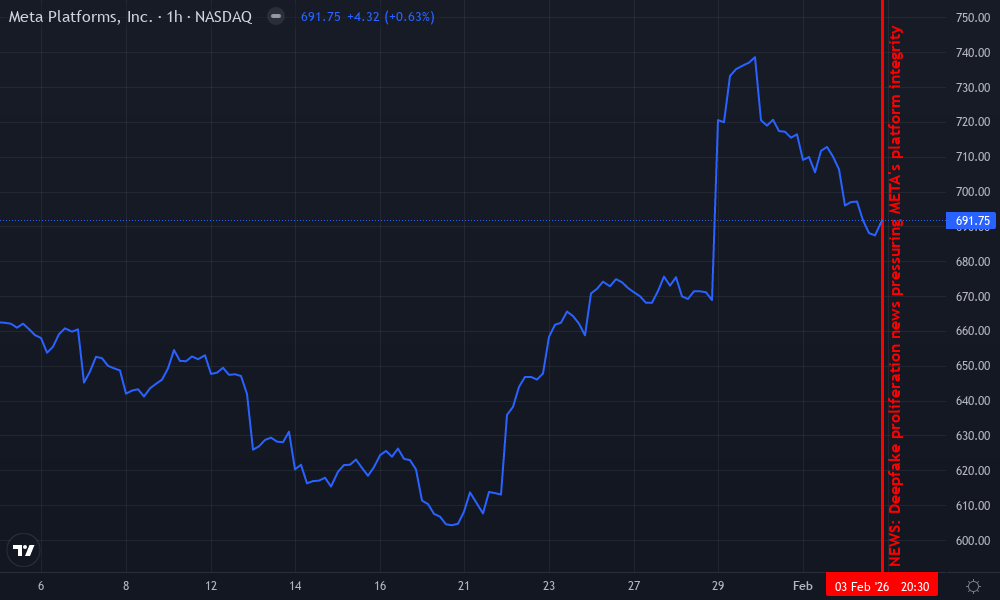
Technical Analysis Summary
To annotate this META chart in my signature style, start by drawing a prominent downtrend line connecting the swing high on 2026-01-23 at $498 to the recent swing high on 2026-01-29 at $486, extending it towards the current price action around $472 for projection. Add an uptrend line from the low on 2026-01-12 at $472 to the peak on 2026-01-23 at $498 to highlight the prior impulse. Mark horizontal lines at key support $470 (strong) and resistance $495 (major). Use a rectangle for the consolidation range between 2026-01-27 ($478) and 2026-01-29 ($486). Place arrow_mark_down on the MACD bearish crossover around 2026-01-29. Add a vertical_line at 2026-02-04 for the deepfake news event. Callout volume spike on the breakdown with 'Bearish volume confirmation'. Short position marker near $480 entry zone, stop_loss at $488, profit_target $460. Text box summary: 'Breakdown underway - watch $470 support.' This setup captures the shift from bull trap to distribution phase.
Risk Assessment: medium
Analysis: Volatile news-driven drop with clear structure but $470 support untested firmly; volume confirms bias but watch for snapback
Robert Wilson's Recommendation: Favor shorts on resistance retests for swing fades, trail stops medium risk - stay nimble as charts evolve
Key Support & Resistance Levels
📈 Support Levels:
- $470 - Recent lows and psychological round number holding the downside strong
- $460 - Prior range low extension if breakdown confirms moderate
📉 Resistance Levels:
- $486 - Recent swing high retest zone moderate
- $498 - Major distribution top from rally peak strong
Trading Zones (medium risk tolerance)
🎯 Entry Zones:
- $480 - Retest of downtrend line and minor resistance for short entry medium risk
- $470 - Support bounce for potential long scalp if volume dries up medium risk
🚪 Exit Zones:
- $460 - Measured move projection from range breakdown 💰 profit target
- $488 - Above short entry resistance invalidation 🛡️ stop loss
- $495 - Resistance retest for long profit 💰 profit target
- $465 - Support breach stop for long 🛡️ stop loss
Technical Indicators Analysis
📊 Volume Analysis:
Pattern: Spike on downside breakdown with divergence on prior upmove
Confirming sellers in control, no buying absorption
📈 MACD Analysis:
Signal: Bearish crossover and histogram expansion negative
Momentum shift solidifying downtrend
Applied TradingView Drawing Utilities
This chart analysis utilizes the following professional drawing tools:
Disclaimer: This technical analysis by Robert Wilson is for educational purposes only and should not be considered as financial advice. Trading involves risk, and you should always do your own research before making investment decisions. Past performance does not guarantee future results. The analysis reflects the author's personal methodology and risk tolerance (medium).
Challenges persist, though. Training multimodal models guzzles GPUs, and cross-domain generalization falters on unseen accents or lighting. Enter contrastive learning from Tech Science Press: it decouples audio-visual domains, slashing false positives by 22% on AIGC videos. Opinionated aside - platforms hoarding proprietary codecs stifle progress; open standards like those in Medium's SynthID explainer could unify the field, mandating watermarks for viral thresholds.
Monetizing Trust: Royalty Rails Meet Detection
Watermarking transcends defense, morphing into revenue engines via royalty rails. AI Watermark Hub leads here, stitching imperceptible markers to smart contracts that track derivatives - a remixed deepfake clip auto-triggers micro-payments to originals. Data-driven proof: Springer’s decoupled watermarks endure 95% of edits, enabling precise attribution. Social media fit? Seamless. Upload a watermarked reel, and blockchain ledgers log views, enforcing licenses without human oversight. This isn't pie-in-sky; it's operational now, fortifying synthetic video detection strategies with economic incentives. Creators pocket royalties from unauthorized shares, platforms dodge liability suits.
Real-world pilots echo efficacy. A 2026 rollout on select TikTok challenges pegged fake infiltration at under 2%, versus 18% baseline, thanks to SIDA's explanatory outputs guiding moderators. Multimodal fusion shines brightest here: visual watermarks corroborate audio hashes, temporal sync verifies lip flaps. As NIH surveys affirm, this holistic lens plugs forensic gaps, hitting 96% aggregate precision.
Forward momentum builds on hybrid vigilance - watermarks as first responders, backed by LLMs for nuanced verdicts. Evolving threats demand iterative hardening; diffusion models now forge watermarks into training losses, preempting evasion. For digital rights holders, the playbook crystallizes: embed early, verify often, monetize always. Platforms adopting these AI media authenticity markers don't just detect deepfakes - they redefine credible content at warp speed, turning vulnerability into velocity.




No comments yet. Be the first to share your thoughts!