

In an era where synthetic media floods digital channels, distinguishing authentic content from AI fabrications demands ironclad safeguards. Spread spectrum steganography watermarks stand out as a methodical bulwark, dispersing proprietary signals across a broad frequency spectrum to embed ownership proofs imperceptibly within images, videos, and audio. This technique, rooted in signal processing resilience, ensures robust AI image watermarks survive manipulations that lesser methods crumble under, from compression to adversarial tampering.
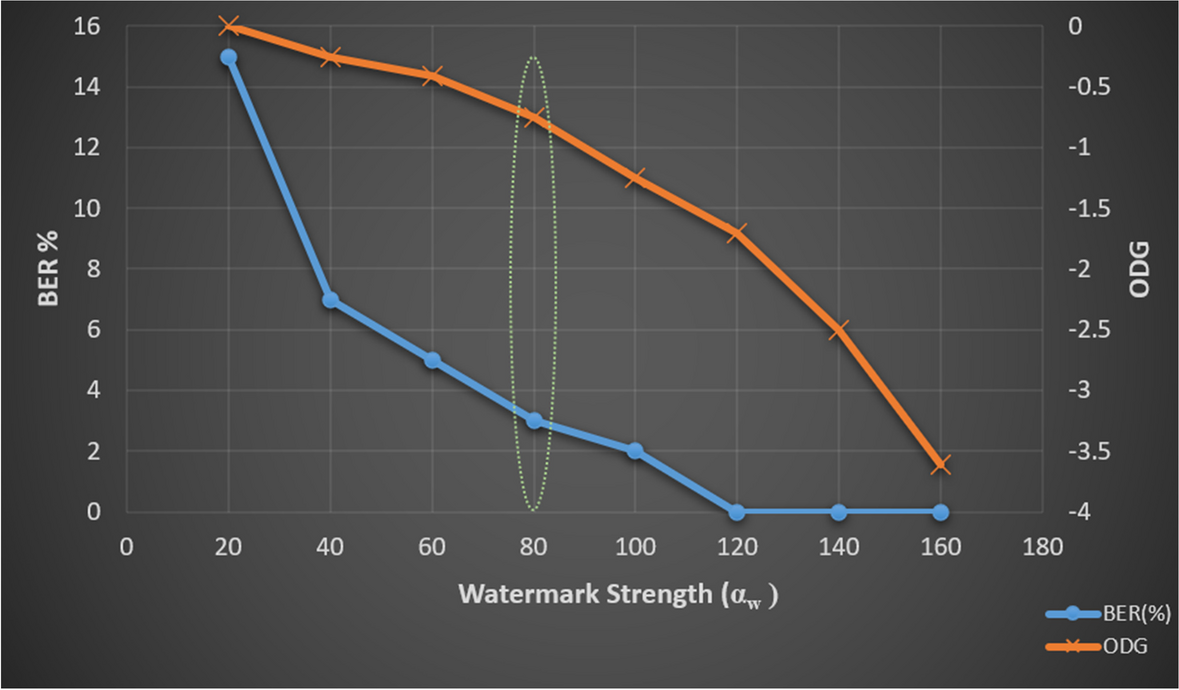
Traditional digital watermarking often falters when media undergoes real-world transformations like cropping, rotation, or resizing. Spread spectrum approaches, however, mimic secure communication protocols by spreading the watermark signal thinly over many frequencies. This dilution renders it nearly invisible to the human eye while fortifying it against detection and excision. Drawing from early methodologies at UCLA and the University of Delaware, these watermarks prioritize tamper-resistance, making them ideal for synthetic media steganography.
Why Spread Spectrum Excels in Synthetic Media Protection
Consider the lifecycle of AI-generated content: it rarely stays pristine. Platforms compress files, users edit semantically, and malicious actors deploy removal tools. Here, spread spectrum shines by distributing the signal widely, so partial losses do not obliterate the message. Unlike visible overlays or fragile metadata, these watermarks integrate at the noise floor, leveraging the noise-tolerant nature of multimedia signals as noted in foundational digital watermarking principles.
From my vantage as a portfolio manager attuned to hedging risks, this mirrors conservative strategies in commodities: diversify to mitigate shocks. Deepfake watermark protection via spread spectrum hedges against the volatility of generative AI, where models like diffusion-based generators churn out hyper-realistic fakes. Recent integrations embed these watermarks directly into latent spaces of diffusion models, coupling them with inherent noise to slash entropy and preserve perceptual fidelity without decoder overhead.

Fortifying Against AI-Driven Removal Onslaughts
Adversaries evolve swiftly. Attacks like MarkSweep exploit high-frequency amplification and denoising networks to slash bit accuracy below 67 percent in targeted schemes, all while keeping images visually intact. This underscores a sobering reality: watermarking alone won't repel all deepfake threats, echoing cautions from security analyses. Yet, spread spectrum's broad distribution frustrates such pinpoint erasures, as reconstructing the full signal post-attack demands improbable precision.
Innovators counter by shifting embedding to the inference phase of generative models, bypassing retraining costs. These inference-time watermarks withstand bounded perturbations and rival top benchmarks in thwarting synthetic removal. Experiments affirm survival through regeneration assaults and edits, vital for content creators and rights holders. Companies pioneering patented forensics, like those surviving compression and resizing, amplify this ecosystem, tracing leaks with forensic precision.
Digimarc Corporation Technical Analysis Chart
Analysis by Market Analyst | Symbol: NASDAQ:DMRC | Interval: 1D | Drawings: 6
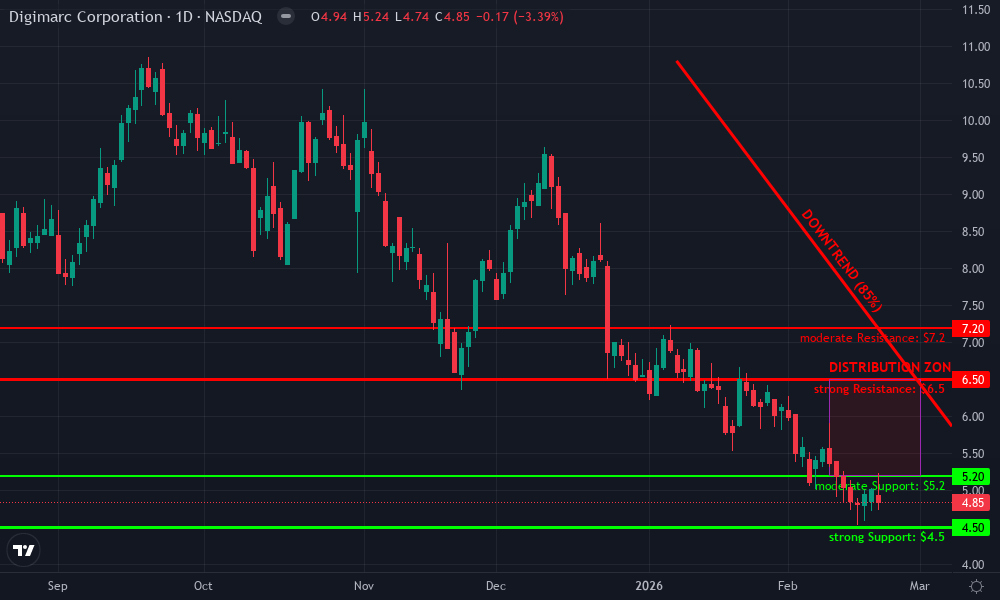
Technical Analysis Summary
As a balanced technical analyst, start by drawing a primary downtrend line connecting the swing high on 2026-01-08 at $10.80 to the recent swing high on 2026-02-20 at $7.20, extending to project continuation below $5.00. Add horizontal support at $4.50 (strong prior low) and resistance at $6.50 (recent consolidation top). Use fib retracement from the major drop: 0% at $10.80, 100% at $4.20, highlighting 38.2% ($6.80) and 61.8% ($6.00) levels. Mark volume spikes on breakdowns with arrow_mark_down callouts. Place entry long zone at $4.80-$5.00 with stop below $4.50, target $6.50. Use rectangle for mid-Feb consolidation 2026-02-10 to 2026-02-28 between $5.50-$6.50. Add text notes for bearish MACD divergence.
Risk Assessment: medium
Analysis: Clear downtrend but near strong support with positive sector news; medium tolerance suits waiting for confirmation
Market Analyst's Recommendation: Consider small long position at $4.80 support with tight stop, target $6.50; avoid if breaks $4.50
Key Support & Resistance Levels
📈 Support Levels:
- $4.5 - Strong multi-touch low from mid-Dec equivalent in 2026 terms strong
- $5.2 - Recent swing low with volume support moderate
📉 Resistance Levels:
- $6.5 - Consolidation ceiling tested multiple times strong
- $7.2 - Prior bounce high, now resistance moderate
Trading Zones (medium risk tolerance)
🎯 Entry Zones:
- $4.8 - Bounce from strong support with potential reversal volume medium risk
- $5.8 - Pullback entry on failed breakdown, fib 50% retrace low risk
🚪 Exit Zones:
- $6.5 - First resistance target 💰 profit target
- $4.2 - Below key support invalidates long 🛡️ stop loss
- $7.5 - Extended target on strong reversal 💰 profit target
Technical Indicators Analysis
📊 Volume Analysis:
Pattern: decreasing on rallies, spiking on breakdowns - bearish divergence
Confirms downtrend strength, lack of buy volume on ups
📈 MACD Analysis:
Signal: bearish crossover with histogram contraction
Momentum fading but still negative, watch for bullish divergence near lows
Applied TradingView Drawing Utilities
This chart analysis utilizes the following professional drawing tools:
Disclaimer: This technical analysis by Market Analyst is for educational purposes only and should not be considered as financial advice. Trading involves risk, and you should always do your own research before making investment decisions. Past performance does not guarantee future results. The analysis reflects the author's personal methodology and risk tolerance (medium).
Deep Learning's Role in Elevating Spread Spectrum Robustness
Deep learning supercharges these foundations. CNNs, GANs, Transformers, and diffusion architectures outpace spatial or frequency-domain classics, per comprehensive reviews. Generative watermarking embeds without quality dips, safeguarding copyrighted assets seamlessly. Opinionated take: while hype swirls around flawless detection, true prudence lies in multi-layered defenses - spread spectrum as the resilient core, augmented by legal standards like C2PA.
This fusion yields AI resistant watermarks that not only attest origins but enforce accountability in an unchecked AI milieu. As adversarial techniques proliferate, continuous refinement ensures these covert markers remain one step ahead, protecting the integrity of synthetic media pipelines.
Practical deployment reveals spread spectrum's edge in real-world scenarios. For content creators grappling with unauthorized AI remixes, these watermarks enable precise origin tracing without compromising aesthetics. Platforms embedding during inference sidestep retraining burdens, a pragmatic choice in fast-evolving generative pipelines. This conservatism aligns with my hedging ethos: fortify essentials before scaling ambitions.
Comparative Robustness Across Watermarking Paradigms
Resilience Comparison: Spread Spectrum vs. Traditional, Deep Learning, and Generative Watermarking
| Watermarking Method | Resilience to Compression | Resilience to Editing | Resilience to Removal Attacks | Key Notes |
|---|---|---|---|---|
| Spread Spectrum Steganography | High ✅ | High ✅ | High ✅ | Distributed across spectrum; resists AI removal, regeneration, semantic edits (MDPI, arXiv, UCLA) |
| Traditional (Spatial/Frequency) | Medium ⚠️ | Medium ⚠️ | Low ❌ | Less robust to transformations; outperformed by modern methods (Wikipedia, DTIC) |
| Deep Learning-based (CNN/GAN/Transformers) | High ✅ | High ✅ | Medium ⚠️ | Vulnerable to MarkSweep denoising attack (arXiv, PMC) |
| Generative Watermarking | High ✅ | High ✅ | High ✅ | Inference-phase embedding; no degradation, robust to perturbations (arXiv, CACM, Steg.AI) |
Examine the table above: spread spectrum consistently outperforms in survival rates post-manipulation, thanks to its frequency dispersion. Traditional methods buckle under cropping or noise; deep learning variants, while potent, demand heavy compute. Spread spectrum strikes a balance, embedding robust AI image watermarks that endure without decoder dependencies, as validated in diffusion model experiments.
Yet, vigilance tempers optimism. MarkSweep-like attacks highlight vulnerabilities in high-frequency concentrations, prompting hybrid defenses. Pairing spread spectrum with C2PA metadata layers creates redundancy, much like diversified bond portfolios weathering inflation. For deepfake watermark protection, this multi-pronged approach mitigates single-point failures, ensuring detectability even if primary signals fade.
Inference-Time Embedding: A Conservative Innovation
Shifting to inference-phase integration marks a shrewd evolution. No model fine-tuning means lower barriers for developers, preserving capital in R and amp;D. These watermarks resist bounded noise and regeneration, matching elite benchmarks. In synthetic media workflows, this translates to seamless protection for images from Stable Diffusion or videos from Sora-like generators, all while royalties rail integration tracks usage downstream.
NVIDIA Corporation Technical Analysis Chart
Analysis by Market Analyst | Symbol: NASDAQ:NVDA | Interval: 1D | Drawings: 7
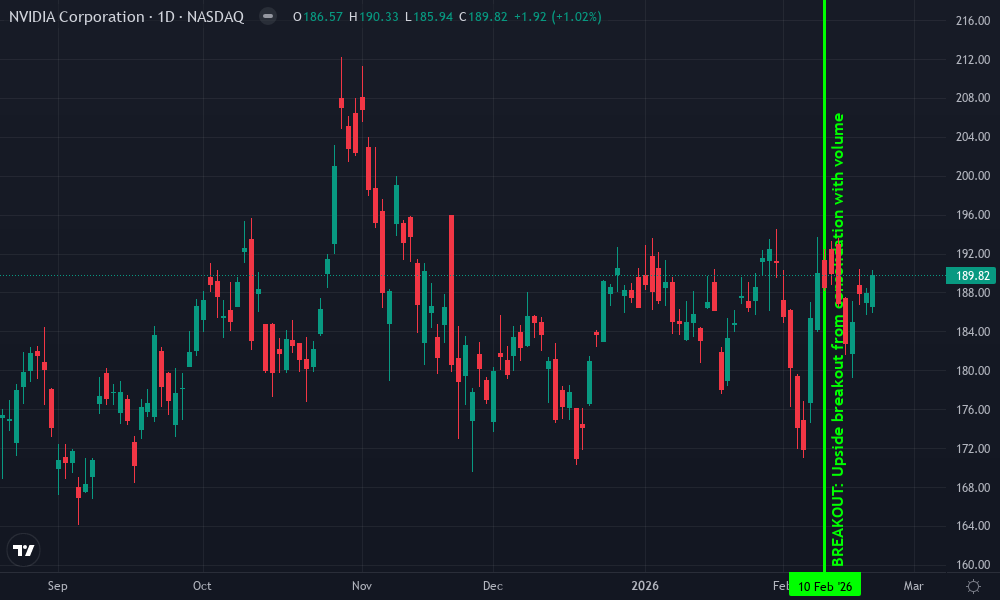
Technical Analysis Summary
To annotate this NVDA chart effectively in my balanced technical style, start by drawing a primary uptrend line connecting the swing low around 2026-10-15 at $118.50 to the recent high on 2026-02-10 at $129.20, using 'trend_line'. Add a short-term downtrend line from 2026-01-20 high $127.80 to 2026-03-15 low $119.80. Mark horizontal support at $118.00 (strong) and $121.00 (moderate), resistance at $128.00 (strong) and $130.00 (weak). Use 'horizontal_line' for these. Draw a consolidation rectangle from 2026-12-01 $122-$126 to 2026-01-15 using 'rectangle'. Add fib retracement from the major low to high. Place entry long zone at $121.50 with 'long_position', profit target $128 with 'order_line', stop $118.50 'short_position' style. For indicators, add 'callout' on volume spike at 2026-02-05 noting bullish volume, and 'arrow_mark_up' on MACD bullish cross 2026-01-25. Vertical line for potential earnings 2026-02-20. Use 'text' for labels like 'Key Support'.
Risk Assessment: medium
Analysis: Uptrend intact but near-term volatility from pullback; confluences support dip buy but $118 break risks deeper correction
Market Analyst's Recommendation: Consider long entries at support with tight stops, target resistance; monitor MACD for confirmation
Key Support & Resistance Levels
📈 Support Levels:
- $118 - Major swing low and psychological level, strong volume shelf strong
- $121 - Recent consolidation base and 38.2% fib retracement moderate
📉 Resistance Levels:
- $128 - Prior high and round number resistance strong
- $130 - Extended target from recent breakout weak
Trading Zones (medium risk tolerance)
🎯 Entry Zones:
- $121.5 - Bounce from support confluences with bullish volume/MACD medium risk
🚪 Exit Zones:
- $128 - Resistance target with prior high 💰 profit target
- $118 - Trend line break invalidates setup 🛡️ stop loss
Technical Indicators Analysis
📊 Volume Analysis:
Pattern: bullish on dips
Increasing volume on green candles during pullback, confirming accumulation
📈 MACD Analysis:
Signal: bullish crossover
MACD line crossing signal from below in late Jan, momentum building
Applied TradingView Drawing Utilities
This chart analysis utilizes the following professional drawing tools:
Disclaimer: This technical analysis by Market Analyst is for educational purposes only and should not be considered as financial advice. Trading involves risk, and you should always do your own research before making investment decisions. Past performance does not guarantee future results. The analysis reflects the author's personal methodology and risk tolerance (medium).
The chart illustrates this tenacity: error rates plateau under sustained assaults, unlike steeper declines in competitors. From a portfolio lens, it's akin to commodities hedging - spread risks to stabilize yields. AI resistant watermarks via spread spectrum thus anchor trust in AI outputs, deterring misuse without stifling creativity.
Ecosystem Integration and Forward Safeguards
Forward-thinking platforms like AI Watermark Hub exemplify this by fusing spread spectrum steganography with royalty rails. Creators watermark at generation, detectors scan distributions, and smart contracts enforce licensing - all imperceptibly. This closed loop protects against leaks, verifies authenticity, and monetizes ethically, addressing gaps where watermarking alone falls short against deepfake speech or video threats.
Challenges persist: as AI removal sophisticates, so must defenses. Expect tighter latent-space couplings and quantum-resistant spectra. My conservative stance: prioritize survival metrics in evaluations, layering steganography with behavioral forensics. In synthetic media's frontier, synthetic media steganography isn't panacea but indispensable bedrock, safeguarding capital - creative and financial - amid generative tempests.
For media firms and developers, adopting spread spectrum now hedges tomorrow's risks. It embeds not just signals, but certainty in an uncertain digital realm.




No comments yet. Be the first to share your thoughts!