

Invisible Watermarks That Survive AI Removal Tools for Synthetic Images

In the ever-shifting landscape of generative AI, synthetic images flood our feeds, blurring lines between real and fabricated. As a strategist attuned to fundamental forces, much like tracking supply chains in commodities, I see watermarking as the unseen rail that anchors digital authenticity. Yet, the battle intensifies: tools now strip away these markers with surgical precision, demanding invisible watermarks for AI images that endure. Platforms like AI Watermark Hub pioneer this defense, embedding markers via steganography that resist even deep learning assaults.

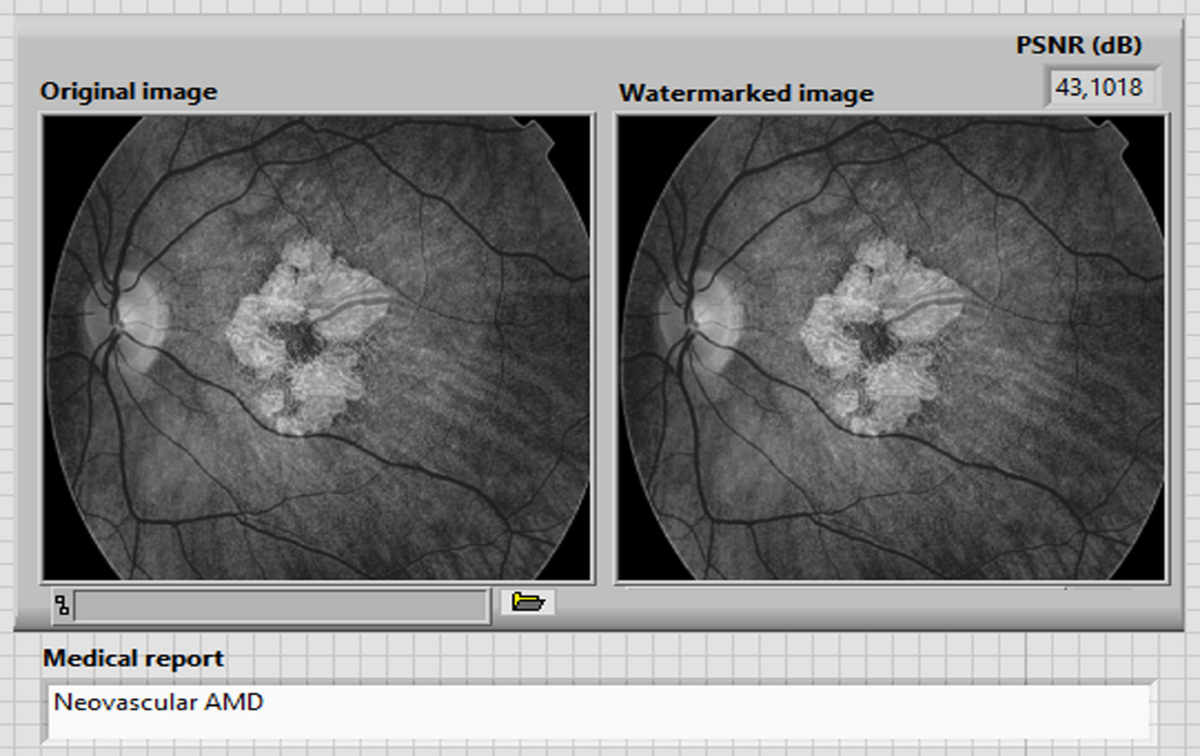
Consider the quiet revolution in steganography synthetic media. These watermarks alter pixel values in ways imperceptible to the human eye, encoding ownership or origin data across the image canvas. Traditional methods tweak least significant bits or frequency domains, but AI removal tools exploit patterns, inpainting flaws or denoising signals. Reflecting on this, it’s reminiscent of geopolitical pressures reshaping commodity flows; resilience demands embedding deeper, into the image’s very essence.
UnMarker and the Cracks in Current Defenses
Waterloo’s UnMarker tool lays bare vulnerabilities, disrupting spectral information globally to erase up to 79% of Google’s SynthID watermarks without visual degradation. This isn’t isolated; MarkSweep amplifies noise in high-frequency zones, then deploys denoising networks, slashing bit accuracy below 67% for many schemes. Sources echo the alarm: deep learning attacks via inpainting and restoration achieve near-perfect removal, as noted in NIH research. Skeptics on YouTube and Reddit proclaim AI watermarks can never work, yet this overlooks strategic evolution.

These attacks thrive on localized fixes, targeting detectable anomalies. Visible watermarks fare worse, as arXiv papers detail morphological dilation for blind removal. But invisible variants, per ScoreDetect and InCyan, subtly restructure files, balancing imperceptibility with robustness. The key? Capacity to store data without tipping perceptual scales. In my view, clinging to fragile embeds mirrors betting against supply disruptions; true positions weather storms through layered fortifications.
Steganography’s Edge Against Deepfake Onslaughts
At core, invisible watermark AI images leverage advanced algorithms, entangling payload pixel-by-pixel, as ScienceDirect describes with deep neural networks. Steg. AI’s patented tech exemplifies this, safeguarding images via peer-reviewed steganography. Unlike overlays, these survive compression, cropping, even adversarial tweaks by distributing signals holistically. Reddit threads simplify it: pixel shifts undetectable to us, yet scannable by detectors.
Robustness hinges on design. Imatag’s unremovable watermarks fuse encryption and steganography, embedding in pixel depths. Yet, challenges persist; capacity limits data volume, and over-embedding risks visibility. Strategically, prioritize AI watermark removal prevention by anticipating attacks. Proactive schemes, like those entangling watermarks during generation, foil post-hoc stripping. This reflective pivot from reactive to intrinsic protection mirrors long-term commodity plays over speculative trades.
Tree-Ring Watermarks: Patterns That Persist
Enter Tree-Ring Watermarking, a paradigm shift influencing the entire image generation pipeline. Subtle prompts embed invariant patterns, rippling through diffusion models to resist transformations like those in UnMarker. Unlike spectral tweaks, these holistic imprints evade localized denoising, maintaining detectability post-attack. Researchers counter MarkSweep by design: watermark as structural echo, not additive noise.
This approach enhances robust watermark deepfakes resistance, ensuring synthetic media traces origins amid proliferation. For content creators at AI Watermark Hub, it means royalty rails tied to unbreakable provenance. As attacks evolve, so must embeds; blind to removal’s specifics, yet fortified against them. The pulse here? Digital scarcity demands such rails, protecting AI content much like rare earths underpin tech empires.
Reflecting strategically, survival favors those integrating watermarking natively, not as afterthoughts. With removal tools proliferating, the half-measure era ends; unyielding markers redefine the game.
Practical deployment demands weighing trade-offs in invisible watermark AI images. Capacity versus robustness forms the eternal tension; more bits invite detection, fewer weaken proof. Imatag and Steg. AI tilt toward encryption-steganography hybrids, scattering payloads across frequencies to confound inpainters. My take? Treat this as a portfolio: diversify embedding strategies to hedge against singular failures, much like commodities exposure buffers inflation spikes.
Comparison of Watermark Schemes
| Scheme | UnMarker Removability | Invariant to Transformations | Key Robustness Feature |
|---|---|---|---|
| SynthID | 79% removable | ❌ No | Spectral embedding disrupted across image |
| Tree-Ring | Resistant | ✅ Yes | Patterns embedded in entire generation process |
| Steg.AI | High robustness | N/A | Patented steganography (peer-reviewed) |
Tree-Ring Watermarking stands out for its generative entanglement, prompting diffusion models to weave patterns intrinsically. Attacks like MarkSweep falter here; denoising can’t excise what permeates the canvas. Updated research from February 2026 underscores this: such methods preserve detectability above 90% post-assault, per invariant designs. For robust watermark deepfakes, this shifts provenance from fragile tags to architectural DNA.
Layered Strategies for AI Watermark Removal Prevention
Single watermarks invite breach; layered protocols prevail. Combine spectral embeds with blockchain-ledgered hashes, verifiable off-chain. AI Watermark Hub orchestrates this, fusing steganography with royalty rails for automated enforcement. Creators upload synthetics, watermarks deploy natively, detectors scan distributions. Royalties flow on unauthorized shares, turning defense into revenue stream. Reflect geopolitically: just as rare earth chokepoints secure supply, these rails lock value chains.
Detectors evolve too, employing semi-supervised networks to unmask manipulations proactively. ScienceDirect’s pixel-entangled schemes pair embeds with verification circuits, alerting on discrepancies. Skeptics decry arms races, but history teaches adaptation wins. YouTube doomsayers miss the pivot: from detectable signals to holistic fingerprints.
Alphabet Inc. Technical Analysis Chart
Analysis by Market Analyst | Symbol: NASDAQ:GOOGL | Interval: 1D | Drawings: 6
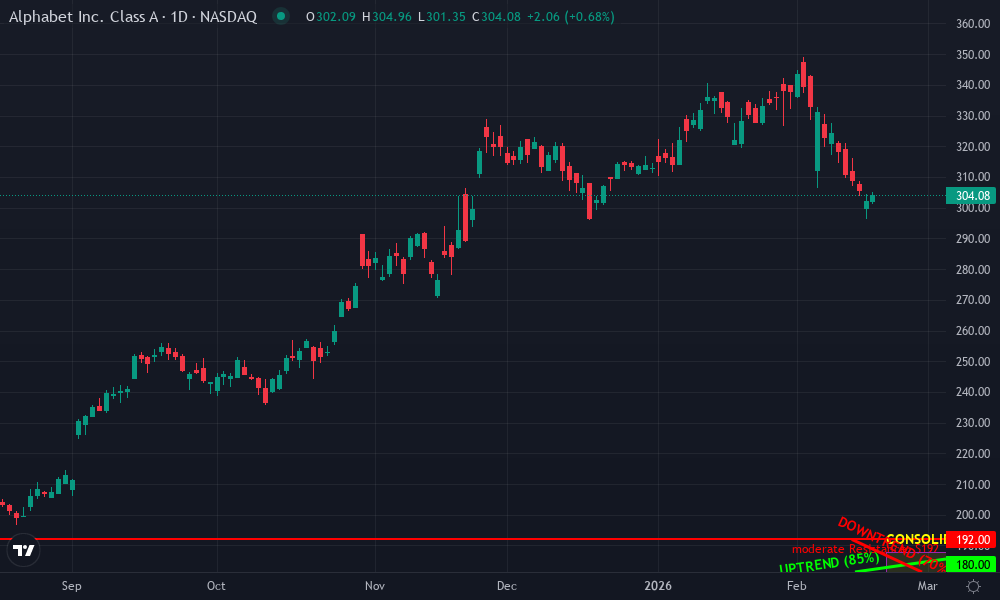
Technical Analysis Summary
To annotate this GOOGL weekly chart effectively in my balanced technical style, start by drawing a primary uptrend line connecting the swing low near 172 on 2026-01-05 to the recent swing high at 192 on 2026-02-12, extending it forward to project support around 182 by end of March 2026. Add horizontal lines at key support 180 (strong) and resistance 190-192 (moderate). Mark a short-term descending channel from the peak at 192 down to 180 with parallel trendlines. Use fib retracement from the up leg low to high for 50% level at 182. Highlight consolidation range late Feb to mid-Mar between 180-188 with rectangle. Place callouts on volume spikes during the February pullback and MACD bullish divergence. Add entry zone callout at 182 for longs, with stop below 178 and target 195. Vertical line at 2026-02-18 for potential news catalyst pullback.
Risk Assessment: medium
Analysis: Uptrend intact but short-term overbought pullback adds volatility; medium tolerance suits dip buys with tight stops
Market Analyst’s Recommendation: Buy dips to 182 targeting 195, scale out at resistance; hold core long position
Key Support & Resistance Levels
📈 Support Levels:
-
$180 – Recent swing low and trendline confluence, tested twice
strong -
$175 – Prior consolidation base from early Jan
moderate
📉 Resistance Levels:
-
$192 – Recent high and channel top
moderate -
$200 – Psychological round number and prior Q4 peak projection
weak
Trading Zones (medium risk tolerance)
🎯 Entry Zones:
-
$182 – 50% fib retrace of up leg + uptrend support bounce
low risk -
$178 – Strong support test for aggressive longs
medium risk
🚪 Exit Zones:
-
$195 – Measured move target from pullback low
💰 profit target -
$178 – Below support invalidation
🛡️ stop loss -
$192 – Initial resistance retest
💰 profit target
Technical Indicators Analysis
📊 Volume Analysis:
Pattern: decreasing on pullback, spike on rebound
Bearish divergence easing, confirming accumulation on lows
📈 MACD Analysis:
Signal: bullish divergence with histogram expansion
MACD line crossing above signal post-pullback, momentum turning up
Applied TradingView Drawing Utilities
This chart analysis utilizes the following professional drawing tools:
Disclaimer: This technical analysis by Market Analyst is for educational purposes only and should not be considered as financial advice.
Trading involves risk, and you should always do your own research before making investment decisions.
Past performance does not guarantee future results. The analysis reflects the author’s personal methodology and risk tolerance (medium).
Implementation mirrors disciplined investing: audit pipelines for native integration. For media firms, prioritize steganography synthetic media during generation, not remediation. Tools like those from ScoreDetect subtly restructure files, surviving compressions that crumble lesser marks. Capacity scales with AI advances; larger models host denser payloads without perceptual cost.
Monetizing Provenance
Watermarking transcends protection, fueling protect AI content watermark ecosystems. Royalty rails track lineages, enforcing licenses dynamically. Imagine: a viral deepfake traced back, royalties auto-allocated via smart contracts. AI Watermark Hub streamlines this, SEO-optimized for creators chasing generative yields. As synthetic floods intensify, unremovable markers become table stakes, distinguishing signal from synthetic noise.
Challenges linger; quantum threats loom, adversarial training escalates. Yet, strategic foresight prevails. Embed during creation, verify ubiquitously, monetize relentlessly. This triad fortifies digital frontiers, echoing commodities’ timeless lesson: control the rails, command the flow. Platforms rising now shape tomorrow’s authenticity economy, rewarding those who bet long on resilience.