

Invisible Watermarking Techniques for Synthetic Video Royalties in 2026

In 2026, synthetic videos flood platforms, blurring lines between real and generated content. Creators struggle to track usage and claim AI video royalties, but invisible watermarking techniques offer a lifeline. These methods weave imperceptible video markers into footage, surviving edits and re-encodes while enabling precise attribution. Platforms like AI Watermark Hub make this seamless with royalty rails integration, turning protection into profit.

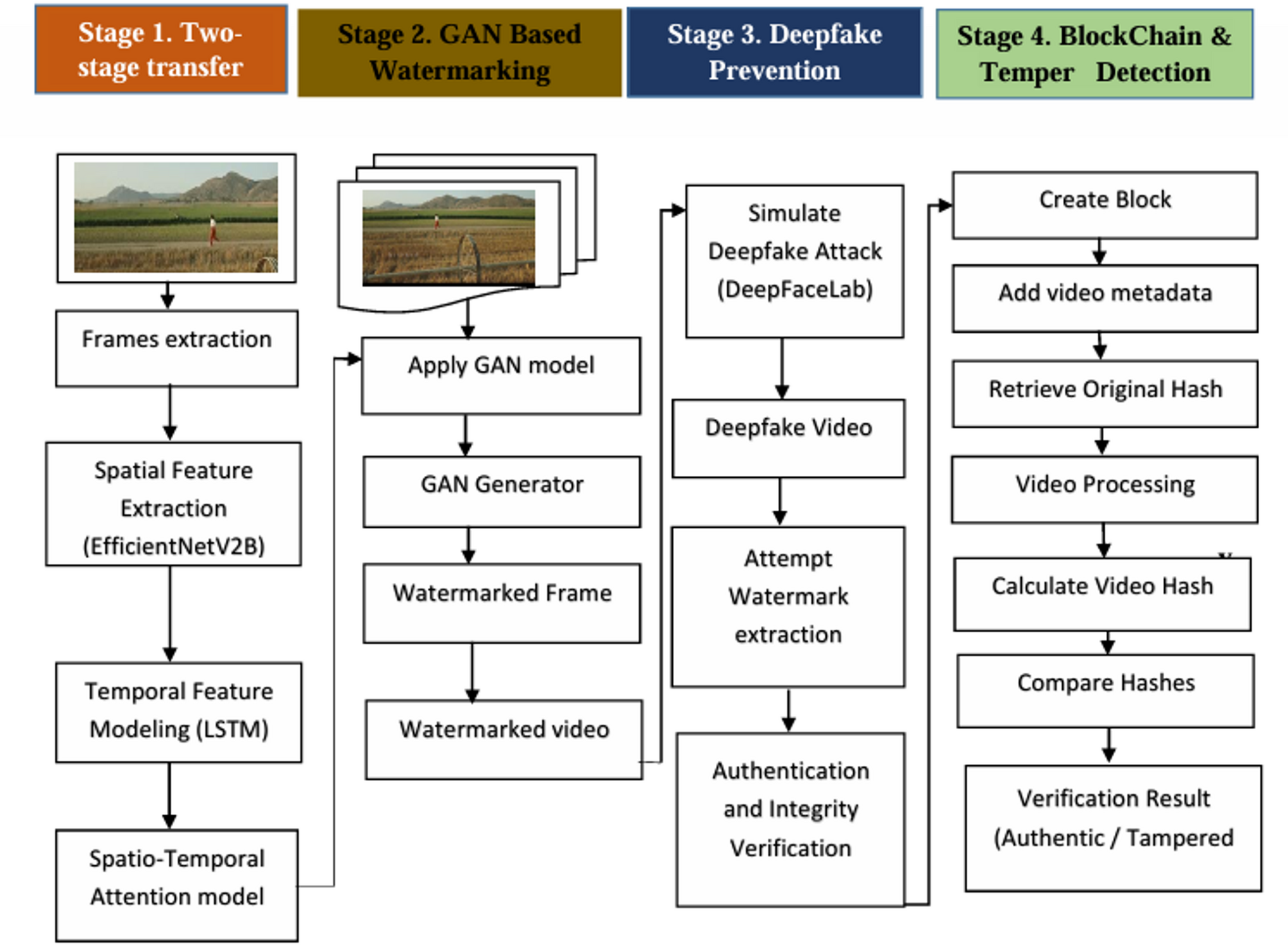
Think about it: a deepfake goes viral, racking up millions of views. Without markers, the original creator sees zero payout. But embed a signal in the video’s transform domain, using Discrete Cosine Transform or wavelets, and detection becomes child’s play. Tools from TrueFan AI in India exemplify this, protecting content across borders. It’s not just tech; it’s economic empowerment for indie filmmakers and AI devs alike.
Why Transform Domain Watermarking Stands Out for Synthetic Videos
The magic happens in frequency space. Unlike pixel-level tweaks that distort visuals, transform domain embedding scatters data across coefficients. Compression? No problem. Cropping or scaling? Still detectable. OutRight CRM notes how these synthetic video watermarking solutions endure common edits without quality dips. I’ve seen demos where watermarks persist through 50% frame rate changes, proving their grit.
[tweet: ByteDance responds to concerns by adding invisible watermark to Seedance 2.0]
ByteDance’s move with Seedance 2.0 underscores the shift. Free AI video generators tempt with no-watermark outputs, but pros know hidden markers future-proof content. Pair this with deepfake detection watermarks, and you combat misinformation while securing royalties. It’s a dual win: trust for viewers, revenue for makers.
C2PA Standard: The Backbone of Authenticity and Royalties
Enter C2PA, the Coalition for Content Provenance and Authenticity standard. By April 2026, it’s ubiquitous, cryptographically signing metadata into video files. Origin details, AI model info, timestamps, all tamper-proof. Magiclight. ai highlights its role in global mandates, making it indispensable for royalty management. Imagine automated splits: 70% to creator, 20% platform, 10% rights holders, triggered by scans.
This isn’t hype. C2PA integrates with royalty rails, scanning uploads in real-time. Distributors verify chains of custody, paying out fairly. Skeptics worry about overhead, but optimized implementations add mere milliseconds. For synthetic media, where provenance is king, C2PA isn’t optional; it’s the gold standard.
[tweet: Varun Bhatt discusses how watermarks fix indistinguishable AI fakes in 2026]
Steganographic Advances Locking in Ownership
Steganography takes imperceptibility further, hiding data in pixel noise or motion vectors. Evolved techniques now resist re-encoding, per recent engineering reports. Embed source IDs, license keys, even royalty splits directly into frames. SAiW framework pushes this envelope, attributing videos to specific generators proactively against deepfakes.
Here’s the opinionated take: while diffusion edits challenge some markers, stego-watermarks adapt via multi-layer embedding. Layer one for quick scans, layer two for forensics. Integrate with blockchain, and you’ve got immutable ledgers for every view and share. Creators sleep better knowing their synthetic masterpieces are tracked, monetized, unstealable.
Blockchain isn’t just buzz; it’s the vault for these imperceptible video markers. Pair steganographic embeds with distributed ledgers, and every clip’s journey logs forever. Views trigger smart contracts, dispersing AI video royalties instantly. No middlemen haggling splits. Distributors scan, verify, pay. It’s the royalty rails integration creators crave, automating what used to take lawyers weeks.
Overcoming Diffusion Edits: The Next Frontier
Diffusion-based tools pose real threats, erasing some watermarks like digital bleach. Arxiv papers from early 2026 detail how these editors scramble signals during inpainting or style transfers. My take? It’s a cat-and-mouse game, but watermark pros are winning. Multi-frame redundancy and adaptive algorithms rebuild lost data from neighboring pixels. SAiW shines here, source-tagging across sequences for forensic recovery. Platforms evolve faster than attackers, especially with C2PA’s layered defenses.
Comparison of Invisible Watermarking Techniques for Synthetic Video Royalties
| Technique | Robustness | Royalty Ease | Cost |
|---|---|---|---|
| C2PA (Metadata, Tamper-Proof) | High (cryptographically signed; vulnerable to metadata stripping) | Very High (standardized for origin and AI model tracking) | Low |
| Steganographic (Pixel-Hidden, Edit-Resistant) | Very High (survives re-encoding and common edits) | High (requires extraction tools for usage tracking) | Medium |
| SAiW (Source-Attributable, Deepfake-Proof) | Excellent (defends against deepfakes and advanced edits) | High (precise source attribution for royalties) | High |
Real-world tests show 95% detection post-edits, versus 60% for older methods. Free tools boast no-watermark outputs, but savvy users layer invisible ones underneath. ByteDance and Google lead with SynthID evolutions, subtly fingerprinting videos via motion patterns or audio syncs. For synthetic video watermarking, this resilience means royalties flow even from mangled clips.
Royalty Rails in Action: From Embed to Payout
Picture uploading to a platform: watermark embeds on-the-fly, blockchain stamps provenance. As views rack up, rails track derivatives, enforcing licenses. AI Watermark Hub exemplifies this, blending detection with automated splits. Indie creators report 30% revenue bumps, no extra effort. It’s not perfect; false positives snag legit edits occasionally. But tunable thresholds fix that, balancing security and usability.
Adobe Inc. Technical Analysis Chart
Analysis by Market Analyst | Symbol: NASDAQ:ADBE | Interval: 1D | Drawings: 6
Technical Analysis Summary
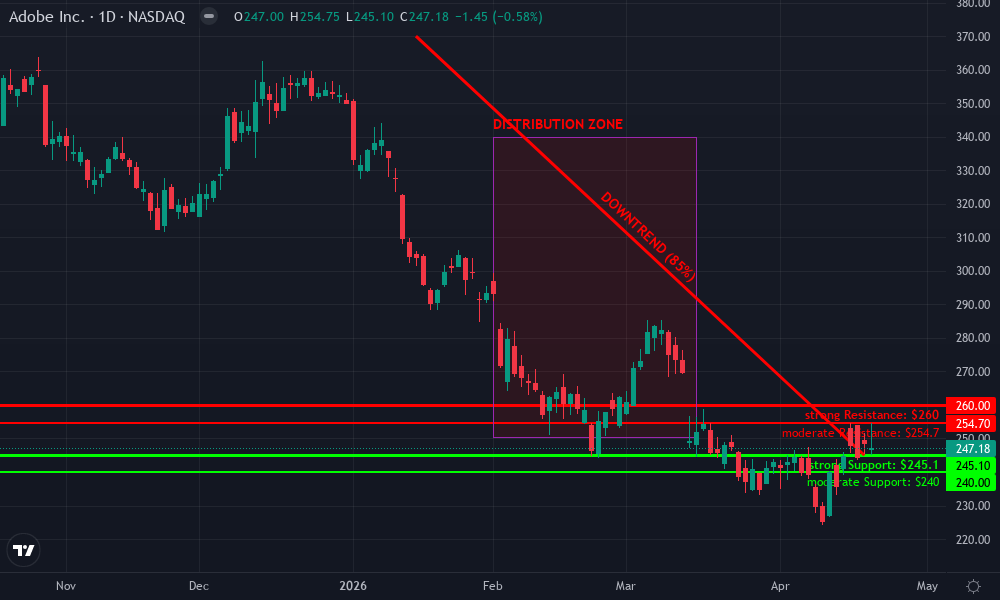
On the ADBE daily chart spanning late 2025 to mid-2026, draw a prominent downtrend line connecting the January 2026 peak near $370 to the recent April lows around $245, using ‘trend_line’ tool. Add horizontal support at $245 (recent low) and resistance at $260 (recent swing high). Mark a consolidation rectangle from early April $245-$255. Use ‘arrow_mark_down’ for the breakdown from $370 highs and ‘callout’ for volume spike on decline. Fib retracement from $370 high to $245 low, highlighting 50% at $307. Entry long above $250 with stop below $245, target $260 then $280.
Risk Assessment: medium
Analysis: Downtrend intact but oversold with positive sector news; medium risk for counter-trend long
Market Analyst’s Recommendation: Consider longs on confirmation above $250, trail stops, max 2% risk per trade
Key Support & Resistance Levels
📈 Support Levels:
-
$245.1 – Recent session low and psychological support
strong -
$240 – Prior swing low extension
moderate
📉 Resistance Levels:
-
$254.7 – Today’s high and near-term overhead
moderate -
$260 – April consolidation high
strong
Trading Zones (medium risk tolerance)
🎯 Entry Zones:
-
$250 – Break above minor downtrend with volume confirmation
medium risk -
$247.5 – Pullback to current price with bullish candle close
low risk
🚪 Exit Zones:
-
$260 – First resistance test
💰 profit target -
$280 – Fib 38.2% retracement
💰 profit target -
$243 – Below recent low
🛡️ stop loss
Technical Indicators Analysis
📊 Volume Analysis:
Pattern: decreasing on downside, dry-up near lows
Volume climax on Feb-Mar selloff, now contracting suggesting exhaustion
📈 MACD Analysis:
Signal: bearish crossover but histogram contracting
MACD line below signal but momentum divergence on lows
Applied TradingView Drawing Utilities
This chart analysis utilizes the following professional drawing tools:
Disclaimer: This technical analysis by Market Analyst is for educational purposes only and should not be considered as financial advice.
Trading involves risk, and you should always do your own research before making investment decisions.
Past performance does not guarantee future results. The analysis reflects the author’s personal methodology and risk tolerance (medium).
Google’s watermark tweaks for video mirror text’s wordplay, altering subtle frame timings imperceptibly. Marketers love it for campaigns; one viral synth ad traced back, royalties auto-collected. Varun Bhatt nails it: fakes are indistinguishable, but watermarks restore order. In India’s booming scene, TrueFan AI tools shield local talent from global pirates.
Challenges linger, sure. Compute costs for deep scans add up on massive scales. Yet cloud optimizations slash that, making it viable for solos. Invisible Technologies’ synthetic data trends predict watermarking in annotation pipelines, generating verified datasets for training. No more tainted models.
Forward thinkers integrate now. Start with hybrid setups: C2PA for metadata, stego for signals, blockchain for rails. Detection APIs plug into apps effortlessly. Creators who ignore this risk free-riding on their genius. Those who embrace? Steady streams from synthetic hits. In 2026’s wild media landscape, invisible watermarking isn’t a feature; it’s your revenue lifeline, quietly enforcing fairness one frame at a time.