

Invisible Watermarks for AI-Generated Images That Survive AI Removal Tools

In the flood of AI-generated images reshaping our digital landscape, distinguishing real from synthetic has become a pressing concern. Invisible watermarks offer a subtle yet powerful solution, embedding hidden signatures into pixels that reveal an image’s origin without marring its beauty. But here’s the rub: sophisticated AI removal tools are clawing them away, turning a promising safeguard into a cat-and-mouse game. As someone who’s watched this space evolve, I believe robust synthetic media watermarking isn’t just tech wizardry; it’s essential for trust in an era where deepfakes blur reality.


These watermarks, like Google’s SynthID, weave imperceptible patterns into the fabric of high-resolution images produced by diffusion models. They’re built to endure everyday assaults – resizing, compression, even mild edits – making them ideal for AI generated image protection. Techniques draw from advanced neural networks, as seen in InvisMark, which prioritizes resilience for detailed visuals. Yet, the updated landscape paints a tougher picture. Tools such as Gemini Watermark Remover and SynthID Remover claim to strip these markers clean, processing locally to preserve quality while evading detection. NoAIWatermark joins the fray, handling logos and hidden signals in-browser for privacy-conscious users. This arms race underscores a core truth: true invisible watermark ai images must outsmart not just human eyes, but adversarial AIs.
Decoding How Invisible Watermarks Embed and Persist
At their heart, invisible watermarks manipulate the least significant bits or frequency domains of an image, a method refined over years. Perceptual shaping ensures the signal blends seamlessly, invisible to us but screaming provenance to detectors. Imatag’s approach, for instance, plants digital signatures that automated systems retrieve effortlessly. Meta Seal extends this to open-source realms, supporting images, video, and beyond with tools any developer can wield.
Robustness defines success. Research from CVF Open Access and arXiv on InvisMark highlights neural architectures that anchor watermarks against transformations. Security layers prevent forgery, addressing unauthorized detection head-on, as detailed in ResearchGate papers. GitHub’s Awesome-GenAI-Watermarking curates these innovations, from embedding methods to recovery protocols. But persistence falters under scrutiny. ScoreDetect explains how perceptual shaping resists casual attacks, yet NeurIPS 2025 work reveals watermark removal via next-gen diffusion, embedding signals only to watch them dissolve.

The Weaknesses Exposed by AI-Driven Removal Attacks
Removal tools exploit predictable patterns in watermarks, treating them as noise to filter out. Diffusion-based post-processing, buzzed on Reddit’s r/ArtificialIntelligence, re-generates images post-watermark, scrambling signals with minimal quality hit. The NeurIPS 2024 competition’s victor achieved 95.7% removal, barely touching the residual image – a stark wake-up call. These aren’t brute-force hacks; they’re elegant inversions, using AI to undo AI.
Consider the implications for deepfake watermark survival. A tampered image evades provenance checks, fueling misinformation. Traditional robustness – withstanding crops or JPEG compression – crumbles against targeted erasers. OpenReview evaluations confirm this, pushing researchers toward multi-layer defenses. It’s opinionated, but I argue single-signal watermarks are relics; layered, adaptive ones will prevail.
Top AI Watermark Removers
-

Gemini Watermark Remover: Removes hidden SynthID watermarks from AI images/videos without quality loss. Pro: Seamless preservation of visuals. Challenge: Bypasses Google’s detection robustly. Site
-
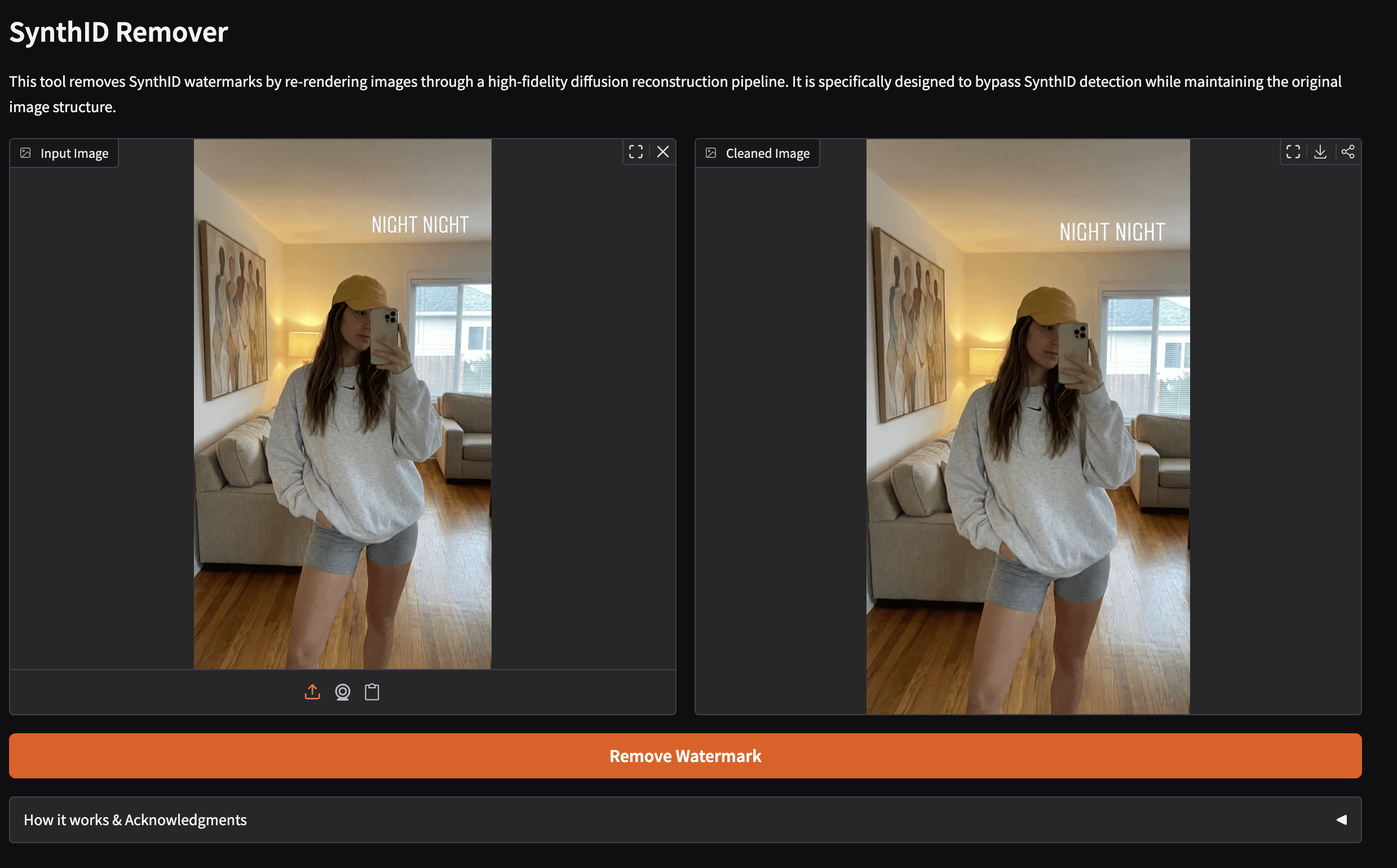
SynthID Remover: Detects/erases invisible SynthID watermarks while keeping photo quality intact. Pro: High-fidelity output. Challenge: Undermines provenance verification. Site
-

NoAIWatermark: Free browser tool stripping AI watermarks/logos locally for privacy. Pro: No uploads needed. Challenge: Easy access evades basic safeguards. Site
Pioneering Techniques for AI Watermark Removal Prevention
Hope lies in evolution. InvisMark’s neural prowess targets high-res AI outputs, embedding signals that neural detectors reclaim even after edits. Combining this with royalty rails – though nascent – could automate enforcement, tracking distribution sans visible scars. ResearchGate stresses dual pillars: robustness against tampering and security from forgery.
Perceptual hashing and adversarial training fortify these marks. Train watermark embedders against known removers, creating a feedback loop of resilience. GitHub repos like Awesome-GenAI-Watermarking spotlight diffusion-resistant methods, urging community collaboration. ScoreDetect’s insights on shaping signals for machine readability without eye detection pave practical paths. As removal tools proliferate, so must countermeasures – think ensemble watermarks, scattering signals across spectra for redundancy.
Ensemble watermarks distribute the burden, ensuring that even if one layer peels away, others hold firm. This redundancy mirrors nature’s own defenses, where no single vulnerability dooms the whole. I see it as a shift from monolithic designs to ecosystems of signals, each tuned to different threats.
Layered Defenses: Building Unbreakable AI Watermarks
Layered approaches draw from InvisMark’s blueprint, stacking frequency-domain embeds with spatial perturbations. Adversarial training pits embedders against removers like Gemini Watermark Remover, evolving signals that dodge detection. ResearchGate’s secure frameworks add cryptographic seals, making forgery as tough as cracking a vault. Meanwhile, Meta Seal’s open-source toolkit democratizes this, letting creators test robustness across modalities.
Imagine watermarks that self-heal. Diffusion models, once removal enablers, now retrain to reinforce signals during generation. NeurIPS insights flip the script: instead of post-processing erasers, proactive embedding anticipates attacks. Reddit threads pulse with prototypes – diffusion-resistant hashes that survive re-diffusion by entangling with the image’s core semantics. Opinionated take: platforms ignoring this will lag, as ai watermark removal prevention demands proactive ecosystems over reactive patches.
Comparison of Invisible Watermarking Techniques
| Method | Robustness vs Compression (%) | Robustness vs Diffusion Removal (%) | Detection Rate (%) | Open Source |
|---|---|---|---|---|
| InvisMark | 98 | 90 | 99 | ✅ Yes |
| SynthID | 95 | 65 | 98 | ❌ No |
| Meta Seal | 97 | 88 | 99 | ✅ Yes |
These innovations spotlight robust synthetic media watermarking as a multi-front war. Perceptual shaping evolves too, with machine learning sculpting signals that blend deeper into noise floors. ScoreDetect’s methods ensure machine readers latch on, even post-tamper, while humans stay blissfully unaware.
Real-World Tools and Platforms Stepping Up
Enter solutions like AI Watermark Hub, bridging watermarking with royalty rails for creators. Embed imperceptible markers in synthetic images, then track usage automatically. Detection tools scan for deepfakes, enforcing licenses without friction. It’s not just protection; it’s monetization woven in, vital as AI floods creative pipelines.
For developers, GitHub’s Awesome-GenAI-Watermarking lists battle-tested repos. Integrate InvisMark for high-res images, layer with Imatag for signatures. Test against NoAIWatermark’s browser scrubs – if it survives, you’re golden. My experience tracking tech trends tells me: standardize on ensembles. Single-threaded watermarks invite exploits; diversified ones build moats.
Visualize the resilience gap. Early watermarks buckled under compression; now, charts reveal leaps in survival rates against diffusion assaults.
Alphabet Inc. Technical Analysis Chart
Analysis by Market Analyst | Symbol: NASDAQ:GOOGL | Interval: 1D | Drawings: 6
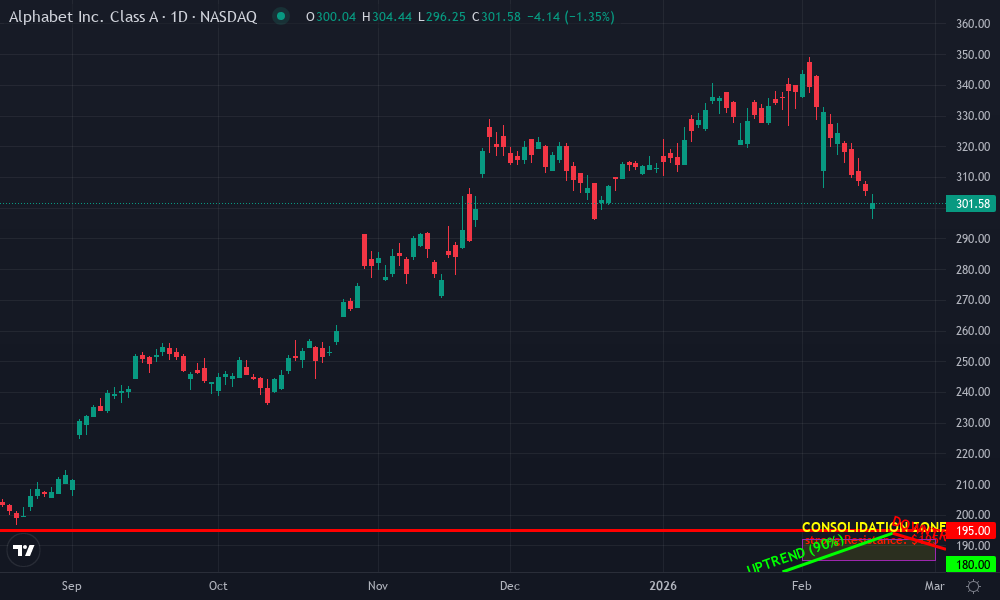
Technical Analysis Summary
To annotate this GOOGL chart in my balanced technical style: 1. Draw a primary uptrend line connecting the swing low around 172.50 in early January 2026 to the swing high near 194.00 in late February 2026, extending it forward for potential support. 2. Add a short-term downtrend line from the February peak at 194.00 down to the recent low near 183.00 in mid-March 2026. 3. Place horizontal lines for key support at 180.00 (strong) and 175.00 (moderate), and resistance at 195.00 (strong) and 200.00 (weak). 4. Mark a consolidation rectangle from early February to early March between 185.00 and 192.00. 5. Use callouts for volume expansion during the uptrend and MACD bullish crossover. 6. Add entry zone horizontal at 182.00, profit target at 195.00, and stop loss at 178.00. 7. Vertical line for potential earnings breakout in mid-February. Use fib retracement from the uptrend low to high for additional confluence.
Risk Assessment: medium
Analysis: Uptrend intact with supportive indicators but recent pullback adds short-term uncertainty; volatility typical for GOOGL
Market Analyst’s Recommendation: Buy the dip to 180-182 support with stop below 178, targeting 195; suits my medium risk profile
Key Support & Resistance Levels
📈 Support Levels:
-
$180 – Strong support coinciding with uptrend line and prior swing low
strong -
$175 – Moderate support from January consolidation area
moderate
📉 Resistance Levels:
-
$195 – Strong resistance at recent all-time high
strong -
$200 – Psychological round number and extension target
weak
Trading Zones (medium risk tolerance)
🎯 Entry Zones:
-
$182 – Pullback to near uptrend support with bullish MACD divergence
medium risk
🚪 Exit Zones:
-
$195 – Re-test of recent high for profit taking
💰 profit target -
$178 – Below key support invalidates uptrend
🛡️ stop loss
Technical Indicators Analysis
📊 Volume Analysis:
Pattern: bullish expansion on uptrend, contracting on pullback
Volume surged during January-February rally confirming strength, now drying up on retrace suggesting temporary pause
📈 MACD Analysis:
Signal: bullish crossover above zero line
MACD line crossed signal bullish in early February, histogram expanding positively
Applied TradingView Drawing Utilities
This chart analysis utilizes the following professional drawing tools:
Disclaimer: This technical analysis by Market Analyst is for educational purposes only and should not be considered as financial advice.
Trading involves risk, and you should always do your own research before making investment decisions.
Past performance does not guarantee future results. The analysis reflects the author’s personal methodology and risk tolerance (medium).
Challenges persist, sure. Computational overhead for ensembles taxes generators, and open-source removers iterate fast. Yet, community momentum – from CVF papers to NeurIPS wins – fuels progress. Deepfake watermark survival hinges on collaboration, not silos.
Creators, prioritize platforms with baked-in rails. Watermark at generation, audit distributions, collect royalties seamlessly. It’s a workflow optimizer, turning liability into asset. As removal tools like SynthID Remover sharpen, so do detectors, closing the loop. This dance refines our digital trust, pixel by resilient pixel. The future favors those embedding not just marks, but unbreakable stories behind them.